


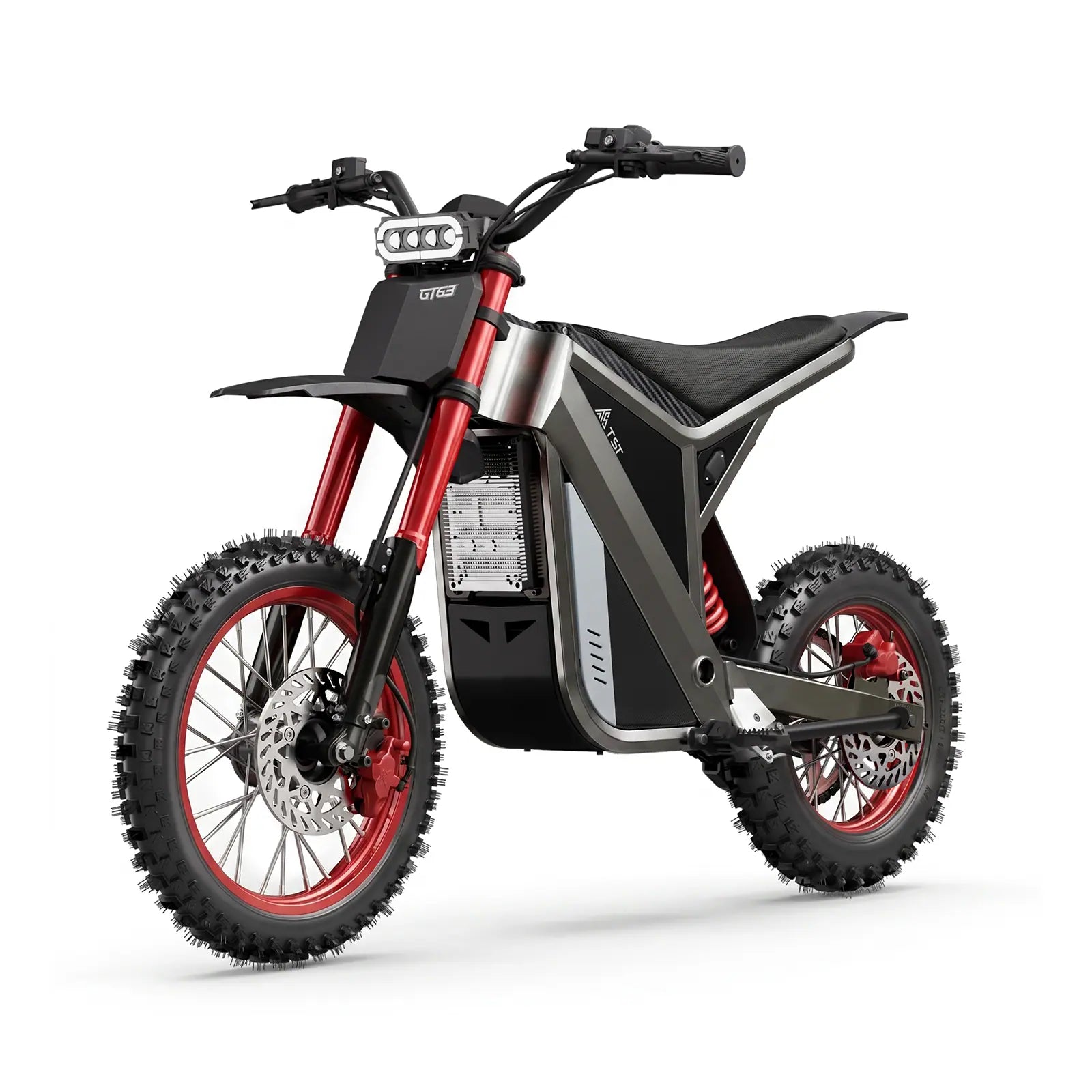














An electric dirt bike is not automatically an e-bike, and pedals, a speed dial, or an "off-road mode" label on the box don't decide whether you can ride it on a street, bike lane, or sidewalk. Whether it's legal comes down to how the exact machine is built, what your state or city calls it, and whether the specific place you want to ride has agreed to allow that category of vehicle. For most electric dirt bikes sold today, the honest answer is no — they are not street legal, and the path to lawful use runs through a land manager or a state DMV, not through the bike's marketing copy.
Why "It Has Pedals" Doesn't Settle Anything
Federal law creates a narrow category called a "low-speed electric bicycle": a two- or three-wheeled vehicle with fully operable pedals and a motor under 750 watts that can't exceed 20 mph on motor power alone with a 170-pound rider. That definition only classifies the product for consumer-safety purposes under the Consumer Product Safety Commission. It does not grant permission to ride on any particular road, path, or trail — that authority belongs to states, cities, and land managers.
Most electric dirt bikes exceed that federal threshold by a wide margin. Motors in the 2,000–8,000-watt range and top speeds well above 28 mph are common, which is why state vehicle codes and local police routinely classify these machines as off-highway vehicles, motor-driven cycles, or motorcycles rather than bicycles. A Virginia police department recently clarified this distinction for residents: bikes meeting the federal e-bike definition can use roads, sidewalks, and bike paths without a license or registration, but many popular electric dirt bikes do not meet that definition because they lack pedals, exceed 35 mph, or are built as off-road motorcycles — and those are not street legal. Canadian police departments have issued nearly identical guidance for the same category of vehicle.
What Actually Determines Legal Status
Four facts control the outcome, and all four have to be checked against the exact configuration you own or plan to buy — not against a general category name.
Vehicle certification and configuration come first. Does the bike meet the federal 750-watt/20-mph pedal-assist definition, or does it exceed it? A bike advertised with a 2,000-watt-plus motor and 40-plus mph top speed does not fit the federal e-bike definition and will not be treated as one by most states, regardless of whether it has pedals.
Jurisdiction matters just as much, since rules differ by state and sometimes by city within a state. Some states have recently created separate categories for higher-powered two-wheelers that allow limited street use if the vehicle is registered, titled, and insured, while other states prohibit electric dirt bikes from public roads, sidewalks, and public trails outright, with registration not curing the prohibition. Some cities have also stepped up enforcement against high-powered "e-motos" on roads, sidewalks, and trails even where a narrow path to street use technically exists for riders holding a driver's license and insurance. There is no single national answer, and rules in this area have shifted within the past year in multiple states.
Registration and title status can block road use entirely. Many electric dirt bikes cannot be registered for road use at all because they lack a VIN and a manufacturer's certificate of origin, which are prerequisites for state titling. Where registration is possible, it typically follows the off-highway vehicle or motorcycle process, not a bicycle process.
Required equipment and operator credentials round out the picture. Converting an off-road-only bike to street use — where a state even allows it — generally means adding DOT-compliant lighting, turn signals, mirrors, a horn, and street-legal tires, then completing state titling, registration, and liability insurance, plus holding the license class the state requires for that vehicle type. None of this is optional paperwork; skipping it is what turns a ride into a citation, an impoundment, or a charge for unlicensed operation.
Where Off-Highway Models Can Be Ridden Lawfully
The lawful home for a dirt-bike-class electric vehicle is off-highway riding areas, not public streets.
California treats electric motorcycles from brands like Sur-Ron, Talaria, and similar off-road-focused builds as off-highway vehicles that require a Green Sticker or Red Sticker from the DMV before they can be ridden even on public OHV-designated land — highway registration is a separate, harder path and doesn't apply to these vehicles. Riding without the correct sticker on OHV trails is itself a citable offense, distinct from the separate question of road use.
On federal recreation land, the National Park Service's e-bike regulation only extends to vehicles meeting the federal "electric bicycle" definition — it explicitly does not apply to electric motorcycles, electric mopeds, or similar higher-powered devices, and e-bikes themselves are permitted only where traditional bicycles already are, never in wilderness areas. An electric dirt bike that exceeds the federal e-bike threshold falls outside this regulation entirely and needs separate authorization from the specific land manager, such as a designated OHV area under a state parks off-highway motor vehicle recreation division or a national forest district.
Local ordinances add another layer on top of state and federal rules. Some municipalities facing a rise in complaints have moved to explicitly limit e-dirt bikes and mini motorcycles to private property or approved off-road areas, barring them from roads, sidewalks, bike lanes, trails, and parks, and stating they cannot be registered or insured for on-road use locally. That kind of blanket local restriction can exist even in places where a state law might theoretically allow a conforming, registered version of the vehicle.
A Practical Verification Sequence
Because the legal outcome depends on the specific bike and the specific place, treat classification as a three-step check rather than a one-time fact.
First, identify the exact configuration: rated motor wattage, top speed, whether pedals are functional and fully operable, and whether the bike has a VIN. This is the information a state uses to decide if the vehicle is a bicycle, a motor-driven cycle, a moped, or a motorcycle under its code.
Second, check the current motor-vehicle or OHV authority for the state and city where you intend to ride — the DMV or equivalent for road and registration questions, and the relevant park or forest service office for trail and off-highway access. Rules change; a policy you read even twelve months ago may no longer be current.
Third, confirm the specific facility's own posted rules before riding, since a land manager can restrict access even when state law would otherwise permit it — the National Park Service's e-bike allowance, for example, is set at the discretion of individual park superintendents.
Where This Leaves a Bike Like the GT63
TST's GT63 electric dirt bike illustrates the category directly rather than being an edge case. Its own product page states a 2200W hub motor and a top speed of up to 43 MPH, which places it well outside the federal 750-watt, 20-mph low-speed-bicycle definition. Consistent with that, TST's own listing states plainly that the GT63 is not street legal and is intended for private property, trails, and off-road riding, adding that street use elsewhere may require a driver's license and compliance with local laws that the buyer must check independently. That self-disclosed status is a starting point, not a substitute for confirming your own state's motor-vehicle and OHV rules before riding anywhere other than private property with permission.
If you're evaluating whether an off-road electric bike fits your riding plans — trail access, backyard use, or a supervised off-highway area — the GT63 product page lists the current configuration, battery, and load specifications so you can match them against your intended riding area's rules before buying, not after.

Leave a comment
This site is protected by hCaptcha and the hCaptcha Privacy Policy and Terms of Service apply.