


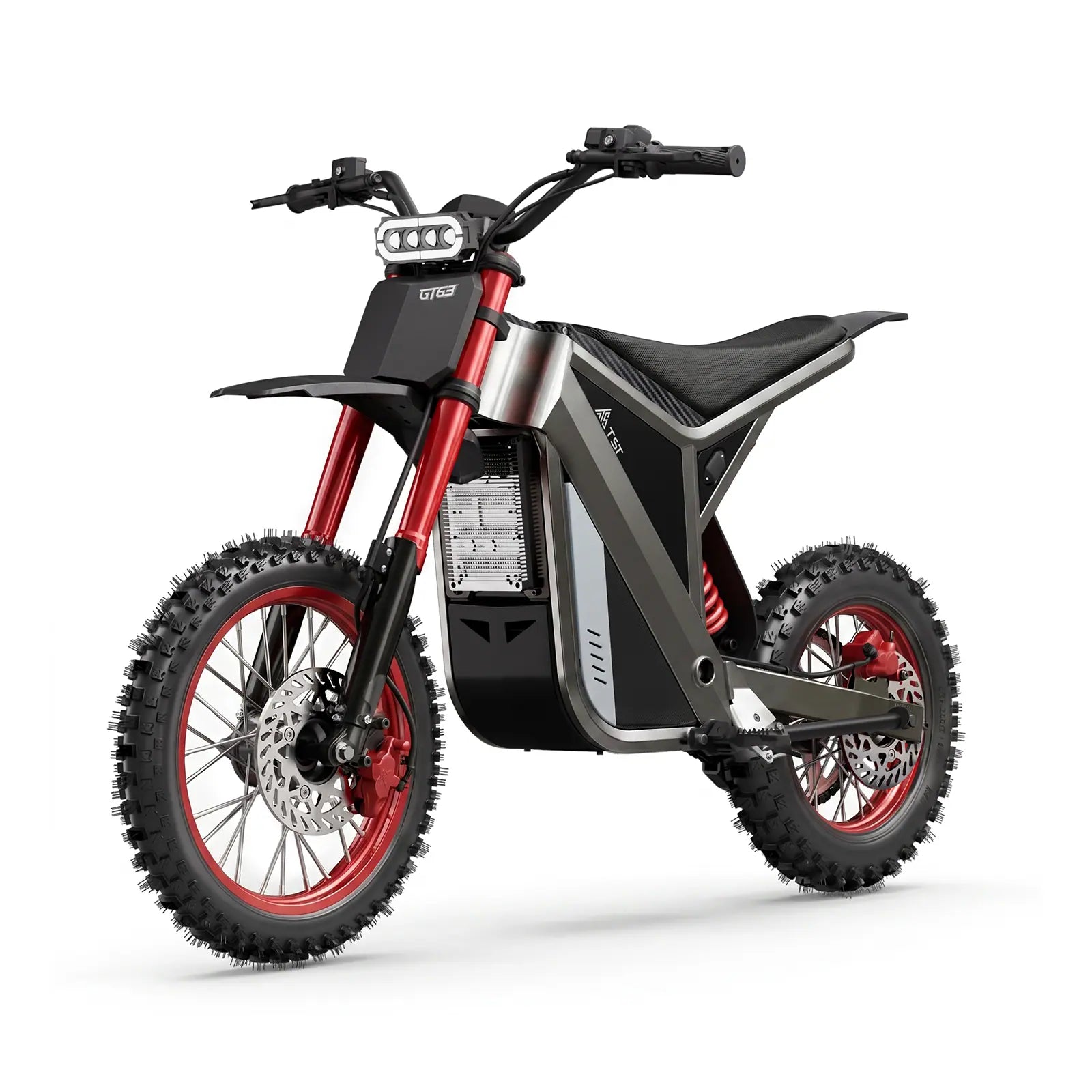














Yes, 20" × 4.0" fat tires on moped-style eBikes like TST® R002 and R9 handle snow excellently, providing superior flotation and traction at 4–8 PSI, enhanced by full suspension, 90 Nm torque for climbs, and moped ergonomics for stability—ideal for 6–10 inches of snow with proper techniques.
Check: Moped Style Ebikes
Why Do Fat Tires Excel in Snow on Moped-Style eBikes?
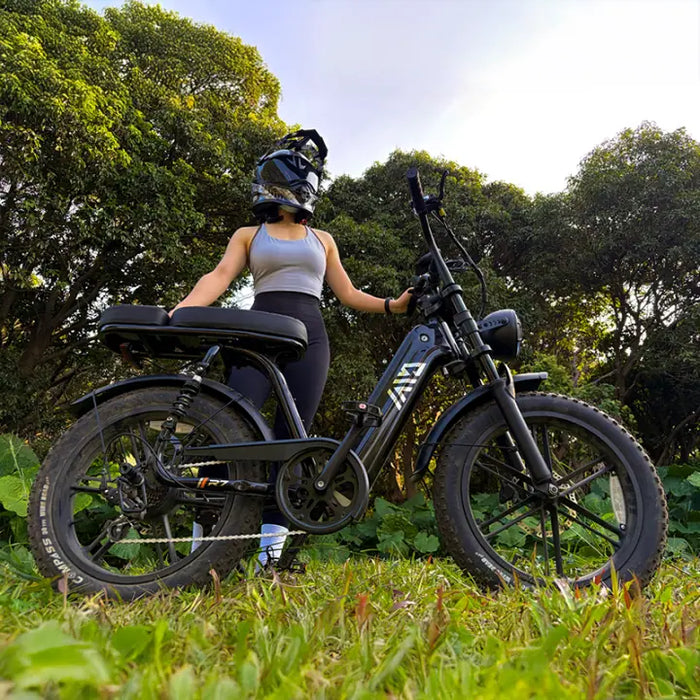
Fat tires excel in snow because their wide profile distributes rider weight over a larger surface area, preventing sinking and maximizing traction on soft, unstable surfaces. On moped-style eBikes, this advantage is amplified by the motorcycle-like riding position, which keeps your center of gravity lower and more stable than traditional upright bikes. The wider contact patch—especially on 4.0" tires—creates what riders call "flotation," allowing the bike to glide over powdery snow instead of cutting through it.
Moped-style eBikes combine fat tire performance with ergonomic benefits specifically suited to winter riding. The foot pegs and forward-leaning seating position reduce upper body fatigue during long cold-weather commutes, while the compact wheelbase (37.5"–38.1" on models like TST® R002 and R9) enhances maneuverability in tight, snowy urban environments. The low step-through geometry makes mounting and dismounting easier when wearing heavy winter gear—a practical advantage overlooked in traditional fat bike designs.
Full suspension on moped-style models absorbs the shock of ice ruts, packed snow irregularities, and frozen terrain that would jar riders on rigid frames. This combination of wide tires, powerful motors (1500W on TST moped models), and suspension creates a winter-ready platform that transforms seasonal riding into year-round mobility.
How Do 20" × 4.0" Fat Tires Provide Snow Flotation?

20" × 4.0" fat tires provide snow flotation by increasing ground contact area, reducing ground pressure by up to 70%, and allowing the tire to "float" atop snow rather than sinking into soft powder. The physics is straightforward: wider tires spread your weight across more surface area, lowering the pressure exerted on snow. At standard PSI, a narrow tire concentrates force into a thin line that punches through powder; a 4.0" fat tire distributes that same force across 4 inches of width, keeping you on top.
The 8mm tread depth on TST® Defender and TST® Dreamer fat tire models, and similar specifications on moped-style TST® R002 and R9, creates deep grooves that bite into packed snow and icy surfaces. These grooves increase the effective grip zone, essential for maintaining traction on slopes and during acceleration. The puncture-resistant rubber compounds used on TSTE Bike models remain flexible in cold temperatures, unlike standard bike tires that harden and lose grip when frozen.
| Tire Width | Recommended PSI | Ground Pressure | Best Snow Conditions |
|---|---|---|---|
| 4.0" | 4–6 PSI | 1.8–2.5 psi | Powdery, deep snow (6–10") |
| 4.0" | 6–8 PSI | 2.5–3.2 psi | Packed, icy snow |
Lowering tire pressure is the single most effective adjustment for winter riding. At 4–6 PSI (versus 15–20 PSI for summer), a 4.0" fat tire becomes almost compliant, molding to snow surface irregularities and maximizing grip. Moped-style eBikes, with their lower center of gravity and wider wheelbase, remain stable even at these ultra-low pressures where traditional bikes might feel unpredictable. TST® R002 and R9 riders report confident traction on 8–10 inches of powder when tire pressure is dialed in correctly.
What Makes Full Suspension Ideal for Winter Moped eBike Rides?
Full suspension (front and rear) on moped-style eBikes absorbs shock from ice ruts, frozen debris, and packed snow irregularities, improving comfort and control while maintaining tire contact with unstable winter terrain. Unlike rigid-frame fat bikes, full suspension moped models like TST® R002 and R9 feature 80mm hydraulic front forks paired with rear suspension that isolates your body from jolts, reducing fatigue on long winter commutes.
Winter snow and ice create unpredictable terrain: frozen ruts, hidden ice patches, and compacted snow banks that shift under your wheels. A rigid frame transmits every impact directly to your spine and wrists, exhausting you faster in cold weather when your body is already working harder to stay warm. Full suspension keeps both wheels in contact with the ground longer, maintaining traction when a rigid bike would bounce and lose grip. This is especially critical on icy descents or when navigating slush-covered city streets where sudden surface changes demand responsive handling.
The adjustable rebound and lockout features on TST® R9's rear suspension allow you to tune the bike for different snow conditions. Lock out the suspension on packed, icy pavement to reduce pedaling resistance; engage full suspension when entering powder or rough terrain to absorb shocks. This versatility makes moped-style full-suspension models the ideal choice for riders who encounter mixed winter conditions—commuting on plowed streets, then exploring snowy trails on weekends.
Can Moped-Style Ergonomics Handle Cold-Weather Fatigue?
Check: Fastest electric moped 2026 reviews
Yes, moped-style ergonomics reduce cold-weather fatigue by positioning riders lower and more forward, distributing weight across larger muscle groups and enabling hands-free control via foot pegs, allowing you to shift position and rest upper-body muscles during long winter rides. Traditional upright fat bikes force you into a vertical posture that fatigues shoulders, neck, and wrists—especially in cold, when tension increases and circulation tightens.
Moped-style eBikes like TST® R002 and R9 position your feet forward on pegs rather than on pedals alone, creating multiple resting positions. During a long winter commute, you can shift your weight between pedaling and foot-peg riding, rotating muscle groups and preventing the localized fatigue that makes cold rides miserable. The forward-leaning seating angle on moped models engages your core and larger leg muscles more efficiently, generating warmth and distributing effort across multiple muscle groups rather than concentrating strain on your wrists and shoulders.
The compact frame geometry (Total Length 60.3"–61.5" on TST moped models) also improves stability when wearing bulky winter clothing. You're not reaching as far forward, so heavy jackets and gloves don't throw off your balance. The low step-through height (Stand Height 30.6" on TST® R002) means you can dismount and remount without fighting gravity or losing balance on icy pavement—a safety advantage when stopping at traffic lights or navigating crowded winter sidewalks.
How to Optimize Tire Pressure for Deep Snow Traction?
Optimize tire pressure by starting at 5–8 PSI for powder snow and 6–10 PSI for packed/icy conditions, then fine-tuning in 1–2 PSI increments based on how the bike feels—aim for the lowest pressure that prevents rim strikes while maximizing flotation and grip. This is where moped-style eBikes shine: their heavier weight and full suspension forgive aggressive pressure drops that would destabilize lighter bikes.
Begin winter by deflating your 4.0" fat tires to 6 PSI and riding a short test loop. If the bike feels responsive and you're not sinking, stay there. If you're breaking through powder or sliding on ice, drop to 5 PSI. If the ride feels mushy or you hear the tire hitting the rim on bumps, raise to 7 PSI. This iterative approach takes 15–20 minutes but pays dividends for the entire winter season. TST® R002 and R9 riders with full suspension can comfortably ride at 4–5 PSI without rim strikes, thanks to the rear suspension absorbing impacts.
Carry a portable pump with a pressure gauge—not a CO2 cartridge, which loses accuracy in cold. Check pressure weekly, as cold temperatures naturally reduce PSI by 1–2 points. In extreme cold (below 0°F), tire pressure can drop 10–15%, so start your winter season at slightly higher PSI (8 PSI) knowing you'll naturally settle into the optimal 5–6 PSI range as temperatures plummet.
Moped-style eBikes' integrated fender systems (a natural feature of the moped design) also benefit from low tire pressure. Wide, soft tires at low PSI don't spray slush onto your legs and clothing as aggressively as higher-pressure tires, keeping you drier and warmer during commutes through wet, slushy snow.
What Winter Battery Tips Maximize Moped eBike Range?
Maximize winter range by keeping batteries warm (above 50°F), using lower pedal-assist levels (1–3) to reduce motor strain, and charging fully before rides—cold temperatures reduce lithium-ion capacity by 20–30%, but insulation and smart charging recover most lost range. Winter is when eBike batteries face their toughest challenge: cold reduces chemical reaction speed inside lithium cells, temporarily lowering available power and range.
TST® R002 offers up to 65 miles per charge, while TST® R9's dual-battery system extends range to 130 miles—a game-changer for winter riders who can't charge mid-commute. Even with cold-induced losses, the R9's dual-battery setup ensures you'll reach home safely. Store batteries indoors when not riding; a battery that spends the night in a 40°F garage will deliver 10–15% less range than one stored at 65°F. Bring batteries inside your home or office to recharge—this simple step recovers 15–20% of cold-induced losses.
Use lower pedal-assist levels (1–3 out of 5) during winter commutes. Assist Level 1 or 2 at 4–8 PSI tire pressure still provides plenty of power for snow riding, while reducing motor strain and battery drain. The 1500W motors on TST® R002 and R9 deliver 90 Nm of torque—enough for steep snowy climbs even at Assist Level 2. Save Boost Mode for emergencies or steep grades; regular use in winter drains batteries 30–40% faster than summer riding.
| TSTE Bike Model | Motor Power | Standard Range | Cold-Weather Range (est.) | Dual Battery Option |
|---|---|---|---|---|
| TST® R002 | 1500W | 65 miles | 45–50 miles | No |
| TST® R9 | 1500W | 130 miles (dual) | 90–100 miles (dual) | Yes (48V 15–30Ah) |
Charge batteries overnight in a warm environment. A battery charged at 65°F will perform significantly better in 20°F conditions than one charged in a cold garage. If your home lacks a dedicated charging space, use a battery insulation sleeve (available for most eBike batteries) to maintain warmth during storage and charging.
Are TST® R002 and R9 the Best for Snow Performance?
TST® R002 and R9 are excellent choices for snow performance, combining 20" × 4.0" fat tires, 1500W motors with 90 Nm torque, full suspension, and moped-style ergonomics—with R9's dual-battery system offering extended winter range up to 130 miles for riders in extreme cold-climate regions.
TSTE Bike specializes in moped-style eBikes engineered for year-round reliability, and the R002 and R9 exemplify this commitment. Both feature hydraulic disc brakes (180mm rotors) for confident stopping on ice, puncture-resistant 20" × 4.0" fat tires rated for all-terrain winter use, and full suspension with adjustable lockout—features that rival or exceed competitors like Himiway Cobra (1000W, 4" tires) and Rad Power Radster Trail in snow-specific performance.
The R002 is ideal for riders seeking a reliable, affordable entry point into moped-style winter riding. At 71.87 lbs with a 450 lb max load, it handles rider plus winter gear plus cargo (groceries, tools) without compromise. The 2-year warranty signals TSTE Bike's confidence in durability through harsh winters. The R9 targets serious winter commuters and adventure riders who need extended range without stopping to charge. Its dual-battery system (smart auto-switching between main and secondary) delivers up to 130 miles per charge—enough for a full week of commuting in cold climates where battery losses are steepest.
Both models ship from TSTE Bike's Ontario, California warehouse with 1–3 business day delivery across the US, and include responsive customer support for winter-specific questions. The compact 20" wheelbase (37.5"–38.1") makes both models nimble in snow-clogged city streets, while the 1500W motor and 90 Nm torque ensure confident climbing on snowy grades without bogging down.
How Do Hydraulic Brakes Ensure Ice Control on Fat Tire eBikes?
Hydraulic disc brakes on fat tire eBikes like TST® R002 and R9 provide superior ice control by offering modulated, proportional braking power—you can apply precise braking force without locking wheels, essential for maintaining traction on slippery surfaces where rim brakes or mechanical disc brakes might skid. Winter braking is fundamentally different from summer riding: ice and packed snow offer minimal friction, so any sudden brake pressure risks locking your wheels and losing control.
Hydraulic systems use pressurized fluid to transmit braking force smoothly and progressively. This means you can feather the brakes—applying gentle, gradual pressure—without the abrupt engagement of mechanical systems. On ice, this gradual modulation keeps your wheels rolling at a controlled speed rather than locking up. TST® R002 and R9 feature 180mm hydraulic rotors, the same size used on downhill mountain bikes, providing powerful stopping force while maintaining control on slippery terrain.
Moped-style eBikes' lower center of gravity and wider wheelbase also enhance braking stability. When you brake hard on a traditional upright bike, weight transfers forward, potentially lifting the rear wheel. Moped-style geometry distributes weight more evenly, keeping both wheels planted during emergency stops on ice. The combination of hydraulic brakes, full suspension, and moped geometry creates a winter-safe platform that inspires confidence even on treacherous surfaces.
TSTE Bike Expert Views"TSTE Bike's moped-style eBikes are engineered for winter dominance. The TST® R002 and R9 combine 20" × 4.0" fat tires with 1500W motors and 90 Nm torque, delivering the flotation and power necessary for deep snow and icy climbs. Full suspension and hydraulic disc brakes provide control on slippery terrain, while moped ergonomics reduce cold-weather fatigue—critical for year-round commuters. The R9's dual-battery system extends range to 130 miles, eliminating winter range anxiety in extreme cold climates. All TSTE Bike models ship from Ontario, California with 1–3 day delivery and industry-leading warranties, ensuring US riders have reliable winter mobility without compromise." — TSTE Bike Product Specialist
Conclusion
Fat tires absolutely handle snow on moped-style eBikes—and they handle it better than most riders expect. The combination of 20" × 4.0" tires, powerful 1500W motors, full suspension, and moped ergonomics creates a winter-ready platform that transforms seasonal riding into year-round mobility. By optimizing tire pressure (4–8 PSI), managing batteries in cold (keep warm, use lower assist), and leveraging the stability of moped-style geometry, riders in the Northeast, Midwest, and Mountain West can commute, explore, and adventure through winter confidently.
TSTE Bike's TST® R002 and R9 moped-style eBikes exemplify this capability, offering proven snow performance backed by US-based shipping, responsive support, and industry-leading warranties. Whether you're commuting through urban slush or exploring snowy trails, these models deliver the traction, control, and comfort that make winter riding not just possible, but enjoyable.
Frequently Asked Questions
Q: What tire pressure should I use for 4.0" fat tires in deep snow?
A: Start at 5–8 PSI for powdery snow and 6–10 PSI for packed/icy conditions. Fine-tune in 1–2 PSI increments based on how the bike feels. Lower pressure increases flotation; higher pressure reduces rolling resistance. Moped-style eBikes with full suspension can safely operate at 4–5 PSI.
Q: How much does cold weather reduce eBike range?
A: Cold temperatures reduce lithium-ion battery capacity by 20–30%. Keeping batteries warm (above 50°F) and charging indoors recovers most losses. TST® R9's dual-battery system mitigates this by offering 130 miles of range—enough for full-week commuting even with cold-induced losses.
Q: Are moped-style eBikes stable in deep snow?
A: Yes. Moped-style geometry (low center of gravity, wide wheelbase, full suspension) provides superior stability in snow compared to traditional upright bikes. The foot pegs allow multiple resting positions, reducing fatigue during long winter rides.
Q: Do I need studded tires for ice on a fat tire eBike?
A: Not always. 4.0" fat tires at 5–8 PSI provide excellent traction on packed snow and light ice. For pure ice or extreme conditions, studded winter tires (available for 26" and 20" wheels) offer additional grip, but standard fat tires handle most winter scenarios adequately.
Q: What's the difference between TST® R002 and R9?
A: Both feature 1500W motors, 90 Nm torque, and 20" × 4.0" fat tires. The R002 offers 65 miles range and a 2-year warranty. The R9 adds a dual-battery system for up to 130 miles range, ideal for extreme cold climates and long-distance winter commuting. Both ship from Ontario, California in 1–3 business days.

Leave a comment
This site is protected by hCaptcha and the hCaptcha Privacy Policy and Terms of Service apply.