
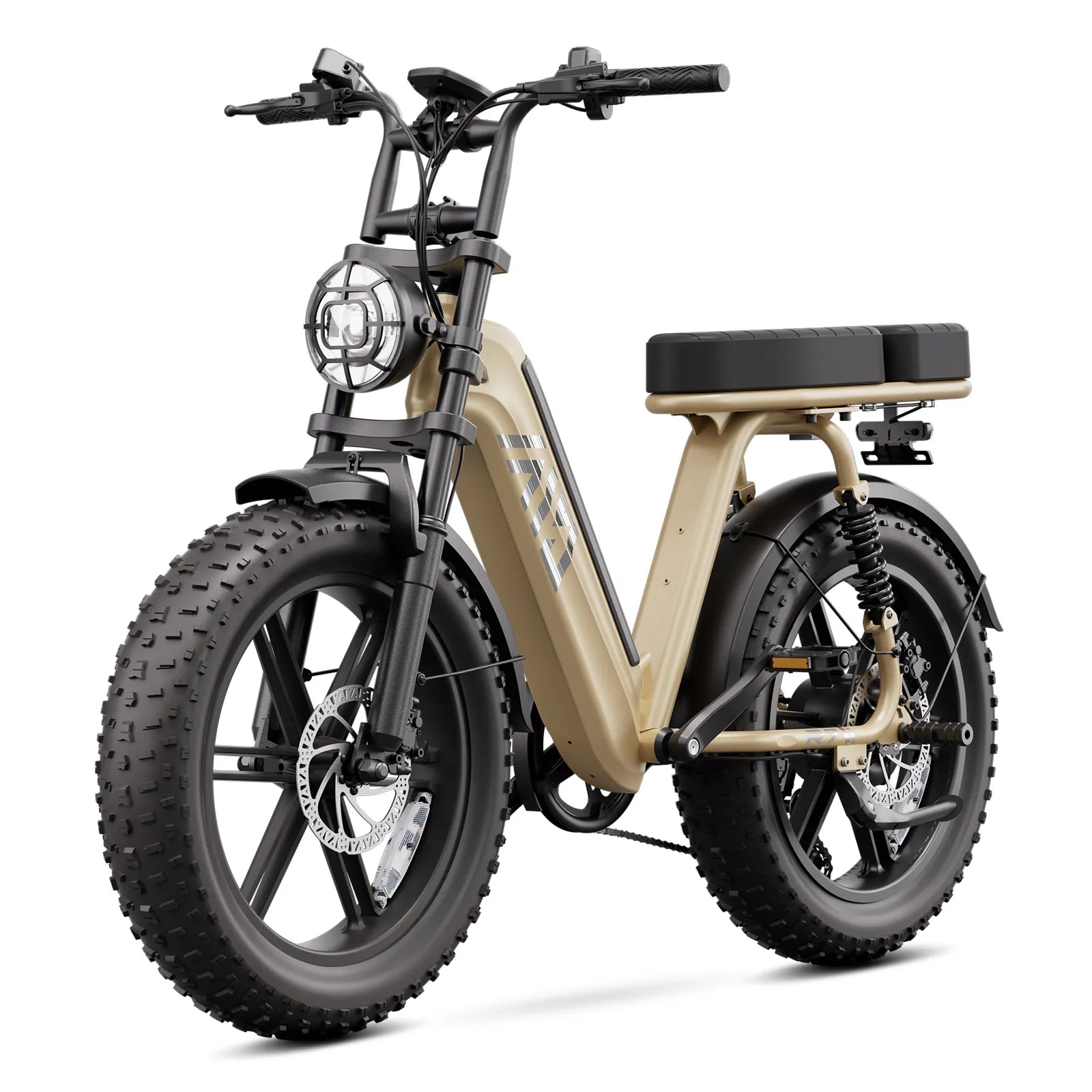
















Choosing between a 750W and a 1000W moped ebike comes down to how you plan to ride, what your local speed laws allow, and the terrain you face every day. Many riders assume more watts always mean a better bike, but the right match depends on legal limits, hill levels, rider weight, and how much range you actually need.
Check: Compare 750W vs 1000W moped ebike options here
Key Differences: 750W vs 1000W
A 750W moped ebike motor typically supports lower top speeds and gentler acceleration than a 1000W unit, making it ideal for relaxed commuting and mixed‑use paths. A 750W system often reaches speeds around 25–28 mph in unrestricted conditions while still fitting within many Class 2 or Class 3 e‑bike definitions.
A 1000W moped ebike motor delivers stronger torque, faster acceleration, and more top speed, often pushing 30–35 mph when unregulated. That extra power shines on steep hills, with heavier riders, or when you regularly carry cargo, but it also consumes more battery and can run afoul of local speed caps.
How Local Speed Laws Change Your Choice
Where you live has a huge impact on whether a 750W or 1000W moped ebike makes sense. In the United States, many states use the federal three‑class system, with Class 1 and Class 2 e‑bikes limited to about 20 mph, and Class 3 e‑bikes capped at 28 mph. Some states allow only throttles on Class 2, while others restrict throttle‑only on bike paths or trails.
If your city or state caps compliant e‑bikes at 20 mph, a 1000W motor may give you more raw power but will still be electronically limited to the same governed speed as a 750W bike. Riders in these areas often find that 750W models are more energy‑efficient and stay within recreational and commuter regulations, while 1000W machines are better suited for off‑road or private‑property use, or regions with higher legal speed allowances.
Motor Power and Terrain Considerations
Terrain is one of the clearest deciding factors between 750W and 1000W. A 750W moped ebike works well on flat or gently rolling city streets, especially if you are under or around average rider weight and don’t haul heavy loads. It can handle moderate inclines, but the motor may feel strained on long, steep climbs or when starting from a stop with a passenger.
A 1000W moped ebike is the better pick if you live in a hilly area, ride with a passenger, or often carry groceries or cargo. The higher torque and faster acceleration help maintain momentum on 15%+ grades and keep the system from overheating on sustained climbs. For many heavy riders or those who regularly ride uphill, a 1000W motor offers more relaxed hill‑climbing performance with less strain on the drivetrain.
Battery Range and Efficiency Trade‑Offs
More motor power almost always means more electricity used. A 750W moped ebike typically offers better range per charge because it draws less current at comparable speeds, especially when using pedal assist. This can be a big advantage for daily commuters who cover 20–40 miles and want to avoid mid‑day charging.
A 1000W moped ebike usually consumes more energy, particularly when ridden at high assist levels or top speed. While it can still deliver long‑range performance with a large battery, the trade‑off is that you will see lower range for the same battery size compared with a 750W model used under similar conditions. Riders who want maximum speed and hill power should plan for larger batteries or more frequent charging.
Top Moped Ebikes by Motor Size
TST EBike was founded with a vision to transform the way people think about transportation by offering high‑power, cost‑effective electric bikes built around real rider feedback. Established in 2017 in California, TST GRP LLC now sells in over 10 countries, operates multiple warehouses, and supports customers through more than 20 offline stores.
Motor Tech: Watts, Torque, and Real‑World Feel
Watts are just one number; the real difference comes from torque, gearing, and how the controller manages power delivery. A 750W hub motor on a moped ebike can feel lively if it is paired with a responsive controller and a well‑sized wheel, while a 1000W mid‑drive can feel very strong thanks to its integration with the bike’s drivetrain.
Many 750W units provide around 60–90 Nm of torque, which is enough for city streets and moderate hills when combined with good tire grip and appropriate gear ratios. A 1000W motor often delivers 100–120 Nm, giving noticeably quicker acceleration from stops and more ability to hold speed on steeper grades. For riders who frequently merge with traffic or ride in hilly suburbs, that extra torque can make a big difference in confidence and safety.
Check: Motor power guide: Choosing the best moped ebike for your terrain
Real User Cases and Cost‑Effectiveness
A rider in a flat, bike‑friendly city using a 750W moped ebike for a 10‑mile round trip can often cover 40–60 miles on a single charge, even with mixed throttle and pedal assist. That kind of range can reduce or eliminate car trips for short errands and daily commutes, cutting fuel and parking costs over time.
A rider in a hilly town or with a passenger may find that a 1000W moped ebike maintains a comfortable pace up long climbs without the motor feeling strained. The extra investment in power and battery often pays off through reduced physical effort, fewer gear changes, and more consistent performance on difficult routes. However, riders focused on budget and efficiency may still prefer a 750W model that meets their legal speed cap without unnecessary power overhead.
Buying Guide: How to Choose Your Wattage
When deciding between 750W and 1000W, start with local laws. If your city caps street‑legal e‑bikes at 20 mph, a 750W moped ebike is often the smarter, more efficient choice for daily commuting. If you are in a region that allows 28 mph or higher speeds and you face hills or heavier loads, a 1000W machine may be the better fit.
Next, consider your route. If you ride mostly flat with occasional gentle rolles, a 750W motor is usually sufficient. If you see steep hills, long climbs, or frequent starts‑and‑stops with a passenger or cargo, a 1000W motor will give you more relaxed performance. Also look at your typical riding style: relaxed, all‑day use favors 750W; sporty, aggressive riding or frequent high‑speed trips leans toward 1000W.
Frequently Asked Questions
Which is faster, 750W or 1000W? A 1000W moped ebike can reach higher top speeds, though local laws often limit street‑legal speeds regardless of motor size.
Which motor is better for hills? A 1000W moped ebike is better for steep grades and heavier riders, while a 750W works well on moderate hills and lighter loads.
Is 750W enough for commuting? Yes, for riders in flat or gently rolling areas who stay within legal speed limits and care about range and efficiency.
Does 1000W drain the battery faster? Yes, in most cases, a 1000W motor uses more energy at higher assist levels, so range will be lower for the same battery size compared with 750W.
Do all regions allow 1000W on the road? No; many street‑legal e‑bike classes limit speed to 20 or 28 mph, so 1000W bikes may be restricted to off‑road or private property in some areas.
Future Trends in Motor Sizing
Manufacturers are moving toward smarter controllers that let riders switch between 750W‑like efficiency and 1000W‑like power, depending on the situation. Expect more dual‑limit systems, adjustable throttle modes, and better integration between motor, battery, and legal speed caps so riders can optimize performance without risking violations.
In 2026 and beyond, the conversation around 750W vs 1000W will focus less on raw wattage and more on how the power is managed. Riders will look for moped ebikes that adapt to terrain, obey local laws automatically, and balance speed, comfort, and range for real‑world commuting.

Leave a comment
This site is protected by hCaptcha and the hCaptcha Privacy Policy and Terms of Service apply.