
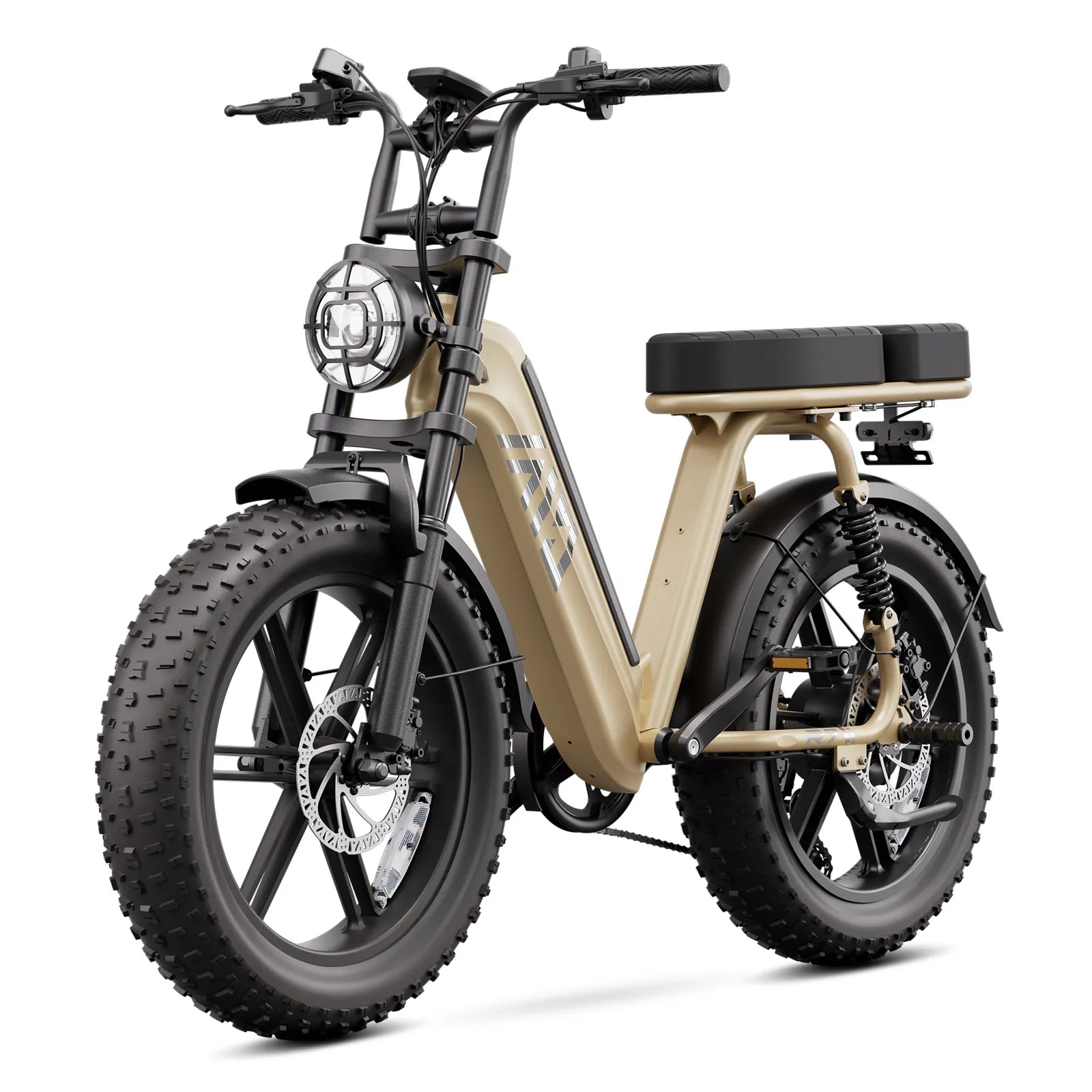
















An electric cargo bike can carry an adult passenger only when four separate things line up: the exact bike and variant were designed for a second rider, an actual passenger seat (not a rack or a child seat) is installed in the position rated for an adult, the combined rider-plus-passenger-plus-cargo weight stays under every relevant limit, and the local rules for that road, path, or trail allow it. If any one of those is missing, the honest answer is no — not "probably fine" and not "the payload rating covers it."
That last part trips up more buyers than anything else. Cargo e-bikes routinely advertise big total payload numbers — 400 lb, 450 lb, 500 lb — and it's tempting to treat that figure as passenger clearance. It isn't. Payload capacity describes what the frame and wheels can structurally bear; it says nothing about whether the bike has a seat rated for a second adult body, whether that seat has the right anchoring and foot protection, or whether the manufacturer or the law actually permits a second person to ride there. Below is how to work through the authorization chain instead of guessing from the spec sheet.
Start with the exact model and variant, not the product category
"Electric cargo bike" covers everything from step-through utility bikes to moped-styled haulers, and passenger provisions differ by model and even by trim. Take the TST® Carrier 20'' Cargo Electric Bike: its current listing specifies a 1300 W peak, 90 Nm rear hub motor, a 48V 15Ah removable battery, hydraulic disc brakes, and a 450 lb total payload capacity, and it ships with a rear rack, fender set, running boards, seat pad, wheel guards, and a children's seat as part of a bundled accessory package. The manufacturer markets the rear carrier area as a "Kid-Safe Passenger Setup" and shows it swapping between a child seat and a 200 lb cargo deck.
That phrasing is deliberate and narrow: it describes a child-passenger configuration, not an adult one. Nothing in the current product listing states that the same rear position, seat pad, or included accessories are rated to carry a second adult. A different cargo bike, or even a different trim of the same bike, can have entirely different hardware, so treat every "does it carry an adult" question as model-and-variant specific rather than assuming one cargo bike's passenger provisions apply to another.
Separate four numbers that get collapsed into one
The biggest error in passenger decisions is using a single headline number — total payload, rack rating, or gross vehicle weight — to answer four different questions. They need to stay separate:
-
Rider weight limit: what the frame, fork, and seat are rated for with one person pedaling.
-
Passenger seat or position rating: the weight limit for whatever hardware is bolted into the passenger position, if the manufacturer sells or supplies one at all.
-
Rack or cargo-deck limit: the load rating for the rear rack or deck, which is a cargo rating, not a passenger rating, and is frequently much lower than total payload.
-
Total payload or gross weight limit: rider plus passenger plus cargo plus accessories combined, which cannot be reached by simply subtracting the bike's own weight from a marketing number.
On the TST Carrier listing, the manufacturer states a 450 lb total payload figure and separately describes the rear carrier as supporting a 200 lb cargo deck configuration when the child seat is removed. Those are two different numbers describing two different configurations of the same rear area, and neither one is presented as an adult-passenger rating. TST's own accessory catalog shows a similar pattern on other models: the 26'' rear rack sold for the Defender and Dreamer platforms carries a maximum load of 66 lb (30 kg) and is explicitly stated to be incompatible with other TST e-bikes. A 66 lb rack rating is far below what an adult passenger weighs, and it illustrates why a rack's load number should never be read as passenger clearance — it is a cargo figure for a specific rack on specific frames.
If a rear rack, cargo deck, or child-seat mount does not carry an explicit statement from the manufacturer that it is rated and approved for an adult rider — in that specific position, on that specific model and variant — the correct default is that it is not approved for that use, regardless of how high the bike's total payload number is.
Check for actual adult passenger hardware, not adjacent accessories
An adult-capable passenger setup, where a manufacturer offers one, typically means a dedicated passenger seat position with its own mounting points, a stated occupant weight rating, foot pegs or running boards positioned and rated for an adult's feet, and some form of hand or grab support. A child seat with a harness, a pannier rack, or a flat cargo deck does not become adult-rated just because a rider chooses to sit on it. The U.S. Consumer Product Safety Commission's micromobility guidance is written around this exact gap: it tells riders to follow all manufacturer directions, review the safety information, and identify weight and age limits for the device before riding, and its general safe-riding guidance for these devices states that only one person should ride per device, since additional riders can increase the risk and severity of collisions. The same logic — that extra, unrated riders increase collision risk and severity — applies to any device where the manufacturer has not built and rated a second-occupant position.
Practically, this means checking three things in the owner's manual and current product listing before assuming a bike can carry an adult passenger: whether an adult passenger seat is listed as available at all for the exact model and variant purchased, what occupant weight and age range that seat is rated for, and whether the manual places any restriction on speed, terrain, or road position when a passenger is aboard. TST's current Carrier listing and help center do not publish an adult-passenger seat as a separate rated accessory; the accessories tied to the model center on a children's seat, running boards sized for that configuration, rear rack, fenders, and wheel guards. Absent a published adult-rated passenger seat and occupant limit for the exact model in question, the manufacturer has not authorized adult passenger carriage in that position.
Improvised seating is a hazard the manufacturer never rated
Riding a second adult on a rear rack, cargo deck, foot pegs meant for a child, or a standing platform without a manufacturer-rated seat is not a gray area — it is riding outside every weight, anchoring, and balance assumption the bike was engineered around. A rack rated for 66 lb of stationary cargo was never tested for a shifting adult body weighing two or three times that, and a bike's stability, braking distance, and low-speed handling all change when an unanchored passenger sits behind the center of gravity. The CPSC's broader micromobility safety guidance stresses checking the device for damage before riding, following manufacturer weight and age limits, and never making abrupt or unpredictable movements while riding, all of which become harder to guarantee with an untested passenger arrangement. There is no configuration in which pegs, a rack, or a cargo deck substitute for a rated passenger seat, and no total-payload number changes that.
Confirm the local rules for the exact road, path, or class involved
Even with a bike and accessory set that are properly rated for a passenger, local law still governs whether, where, and how that passenger can ride. Two things matter most in the United States: the bike's power rating relative to the federal and state e-bike thresholds, and the passenger-specific helmet and age rules in the state where it will be ridden.
Federal law defines a low-speed electric bicycle as a two- or three-wheeled vehicle with operable pedals and a motor rated under 750 watts, with a motor-only top speed under 20 mph. California's own e-bike statute, Vehicle Code section 312.5, uses the same 750-watt ceiling: an electric bicycle under California law must have a motor of no more than 750 watts, and a bike above that threshold falls outside the three-class e-bike system and can instead be treated as a motor-driven cycle or moped, which brings registration and licensing requirements that ordinary e-bikes don't carry. This is directly relevant to cargo bikes marketed with high peak-wattage motors: TST's current Carrier listing states a 1300 W peak motor rating, which is above the 750 W threshold that both federal law and California's e-bike statute use to define a qualifying e-bike. Where a bike's rated or peak motor output sits relative to that threshold, and how the seller labels it, affects which vehicle category — and which passenger and licensing rules — actually apply in a given state; riders should not assume standard e-bike passenger and bike-lane rules automatically apply to a bike marketed above that wattage line without checking the applicable state statute for the exact model as configured.
Within California's e-bike framework specifically, passenger rules are tied to helmets and age rather than a blanket passenger ban: state law requires any bicycle passenger under 18 to wear a CPSC- or ASTM-compliant helmet, and requires every rider and every passenger on a Class 3 e-bike to wear a helmet regardless of age, with a minimum operator age of 16 for Class 3. California's bicycle advocacy coalition summarizes the passenger rule for e-bikes generally as: an e-bike that is set up to accommodate a passenger is permitted to carry one, with the age-based and Class 3 helmet rules applying to whoever rides in that seat. None of these state helmet and age rules substitute for manufacturer approval of the seat itself — they apply on top of it, and only once the bike, variant, and seat are otherwise authorized for that passenger. Riders outside California must check their own state and local rules, since helmet age thresholds, path and trail access, and treatment of high-wattage bikes vary by jurisdiction.
The authorization chain, end to end
Putting the pieces together, a workable decision path looks like this: identify the exact model and variant; confirm the manufacturer has published an adult-rated passenger seat position for that exact configuration, with its own occupant weight limit; confirm the rider's weight, the passenger's weight, and any cargo together stay under the rider limit, the passenger-position limit, and the total payload limit, checked separately rather than combined into one number; confirm the passenger position includes rated foot support and hand or grab support, not an improvised substitute; and confirm current state and local law for the road, bike lane, path, or trail involved, including helmet and minimum-age rules and whether the bike's motor rating keeps it inside that jurisdiction's e-bike definition. A break anywhere in that chain means the answer is no for that specific bike, seat, and route — not a judgment call to be resolved by riding cautiously.
For the TST Carrier 20'' specifically, current published information supports a rear cargo/child-seat area with stated 450 lb total payload and a 200 lb cargo-deck configuration, but does not publish an adult-passenger seat rating for that position, and lists a 1300 W peak motor that sits above the federal and California 750 W e-bike threshold. Anyone considering that model, or any other cargo e-bike, for adult passenger use should verify the current adult-passenger accessory status directly with TST support and the owner's manual for the exact unit purchased, since accessory offerings and manuals can be updated after this check. Where no adult-rated passenger seat is confirmed for the exact model and variant, the bike should be used for cargo and child transport as configured and rated — not for carrying an adult passenger.

Leave a comment
This site is protected by hCaptcha and the hCaptcha Privacy Policy and Terms of Service apply.