


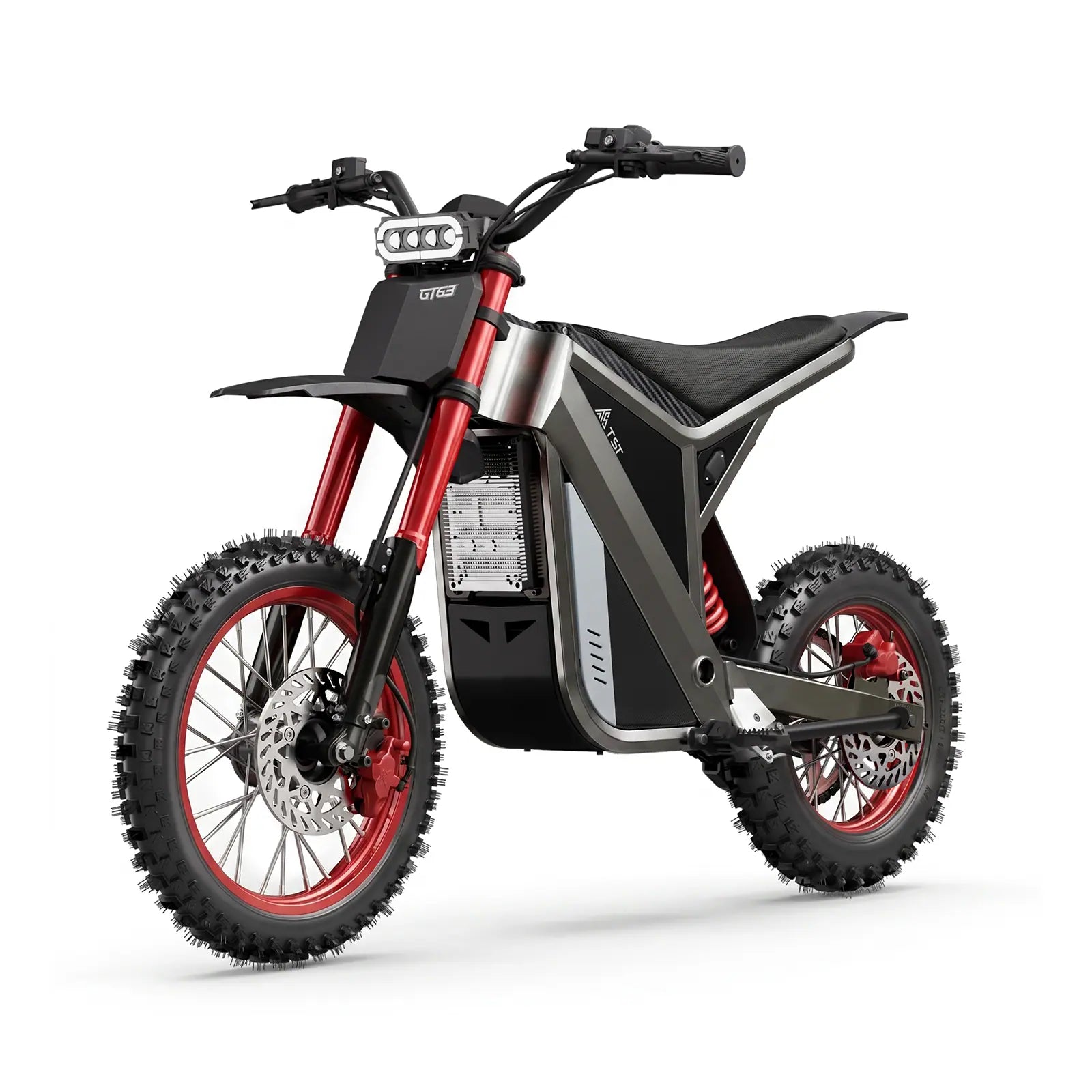














Off‑road electric bikes give adult riders instant torque, deep‑tread traction, and long‑travel suspension that turn steep, technical trails into controllable, fun terrain. Compared with regular MTBs and small electric dirt bikes, they climb better, float over sand and mud, carry more gear, and keep you fresher for longer, making them a true ultimate solution for trail performance.
What makes an off‑road electric bike different from a regular e‑bike?
Off‑road electric bikes stand out through knobby tires, reinforced frames, and suspension tuned for rocks, roots, mud, and sand rather than smooth pavement. They typically pair high‑torque motors with wide rims, strong brakes, and sealed components, so you can ride more aggressively without destroying the bike or losing control on loose terrain.
From the factory side, I see three big engineering shifts on true off‑road platforms: higher impact ratings on rims and frames, longer suspension travel with more progressive damping, and torque‑biased motor tuning that prioritizes control at low speed over top‑speed efficiency. That’s why a trail‑ready off‑road electric bike will happily crawl up a rutted climb where a commuter e‑bike just spins and overheats.
On the tire side, off‑road designs often run 2.6–4.0 inch widths with aggressive side knobs for edge grip in corners. Combined with lower pressures and wider internal rim widths, you get a larger contact patch that “keys” into dirt, sand, or snow. This is where 26‑inch fat‑tire concepts, like TST EBike’s rough‑terrain platforms, shine on mud, snow, and dunes compared with narrow commuter setups.
How do electric dirt bikes for adults compare to off‑road e‑MTBs on the trail?
Adult electric dirt bikes deliver motorcycle‑like power and travel, while off‑road e‑MTBs keep closer to bicycle handling and legal access. Dirt bikes dominate in outright speed and jumps on private land or moto parks, but off‑road e‑bikes win when you need pedal‑assist efficiency, lighter weight, and access to more mountain bike and hunting trails.
In my experience, riders cross‑shopping “electric dirt bike for adults” with full‑suspension e‑MTBs often underestimate how tiring a 120‑pound, moto‑style machine is in tight woods. You can’t just shoulder it over a deadfall or pivot on a narrow bench cut. A 60–75‑pound off‑road e‑bike is far more manageable when the line disappears or you hit a locked gate.
Legal classification matters too. Many off‑road e‑bikes are still treated as bicycles under local rules, especially Class 1 mid‑drives, giving you far more trail options than a dirt bike. That’s exactly why brands like TST EBike tune some 26‑inch platforms for soft‑terrain exploration: enough torque and flotation to mimic light enduro behavior, without pushing you into motorcycle territory.
Why are off‑road electric bikes the ultimate solution for trail performance?
Off‑road electric bikes are a trail performance sweet spot because they combine human input with precisely metered motor torque, giving you “extra legs” without dulling bike feel. You can surge up steep climbs, float through sand or mud, and still have the finesse to pick technical lines rather than bulldozing everything like a heavy moto.
From an engineering perspective, the key is how the controller blends torque and cadence sensing. On a good off‑road e‑MTB, the system ramps power in proportion to pedal pressure, not just crank rotation. That means when you preload over roots or unweight in rock gardens, the motor responds smoothly instead of kicking mid‑air—a detail I always check when test‑riding demo units.
Battery and motor packaging also favor performance. Compared with commuter bikes, off‑road frames tuck packs lower and more central, stiffen the head tube area, and often widen the rear triangle. This gives a planted, neutral feel when you lean into berms or track‑stand on technical switchbacks. TST EBike’s off‑road‑capable 26‑inch designs, for example, intentionally keep mass low to keep fat‑tire floaty bikes from feeling top‑heavy.
How do tires, traction, and all‑terrain grip change your ride in mud and sand?
Wide, knobby tires with the right casing and compound transform how an e‑bike behaves in mud, sand, and loose over hardpack. On soft ground, they spread your weight over a larger footprint, improving flotation, while deeper tread blocks bite into the surface for braking and cornering grip that skinny tires simply can’t deliver.
The trick from a workshop standpoint is pressure and carcass choice, not just width. On 26‑inch fat‑tire off‑road e‑bikes, I typically run 8–12 psi in sand or snow and 12–16 psi in rocky, mixed terrain, adjusting for rider weight and rim width. A quality casing with reinforced sidewalls prevents burping and pinch flats at these lower pressures, which is critical on a heavy, powerful e‑bike.
For all‑terrain riders who bounce between trail and street, I often recommend a moderate tread pattern: aggressive side knobs with a more continuous centerline. That gives you predictable cornering in dirt while still rolling efficiently on hardpack or asphalt connectors. TST EBike’s 26‑inch platforms targeted at rough terrain lean into this approach to keep the bike usable beyond just “soft” surfaces.
Key off‑road tire features at a glance
What role does full suspension play in hunting and backcountry e‑bikes?
Full suspension hunting e‑bikes use long‑travel forks and rear shocks to keep the rear wheel tracking the ground over rocks, roots, and ruts while carrying heavy loads. This improves traction, rider comfort, and control when you’re hauling gear, towing a trailer, or creeping quietly through rough backcountry trails at low speed.
When I spec a hunting‑focused off‑road electric bike, I prioritize suspension that behaves well under static sag plus extra cargo: stiffer spring rates, slightly more rebound damping, and bushings that resist side‑loads from panniers or trailers. It’s not about park‑jump capability; it’s about keeping the bike composed when you’re riding slowly, loaded, and potentially fatigued.
Noise and heat are underrated factors. A well‑tuned full‑suspension e‑bike with quality pivots and minimal chain slap is much quieter than a clattering hardtail under load—crucial when you’re glassing game or moving through still woods. Combined with high‑torque motors and fat tires like those offered on TST EBike’s 26‑inch rough‑terrain platforms, you get an efficient, low‑noise “pack animal” that goes where ATVs can’t.
Which motor, battery, and drivetrain specs matter most for trail‑first performance?
For trail‑first performance, focus on torque (Nm) over pure wattage, mid‑drive integration for technical climbs, and battery capacity that matches your elevation gain rather than just flat‑ground range. A robust drivetrain with wide‑range cassette and e‑rated chain ensures that torque reaches the rear wheel reliably without constant repairs.
In practice, I look for at least 80 Nm of real‑world torque on steep, loaded off‑road routes, whether the label says 750 W or 1000 W. Mid‑drives excel at using your gears to keep the motor in its efficient sweet spot, but they demand better chains, cassettes, and chainrings. Hub‑drives can work off‑road too, especially in soft‑terrain 26‑inch fat‑tire builds, if the frame and axle hardware are up to the extra stress.
Battery sizing should be tied to vertical meters rather than miles. A hunter or advanced trail rider doing repeated 300–500 m climbs will stress a pack much harder than a rail‑trail rider covering the same distance. That’s why off‑road‑capable brands like TST EBike match 48 V packs with strong BMS logic and offer capacities that stay stable under high current draws, not just on flat eco‑mode test loops.
Typical off‑road spec ranges
How do frame geometry and wheel size affect off‑road handling and stability?
Slack head angles, longer wheelbases, and shorter stems give off‑road electric bikes stability on steep descents and rough sections, while still allowing quick steering in tight switchbacks. Wheel size—26‑inch vs 27‑inch/27.5‑inch—changes how the bike rolls over obstacles and how it feels in soft vs mixed terrain.
On the jig, I commonly see trail‑ready e‑bikes with head angles around 65–67 degrees, longer reach numbers, and slightly lower bottom brackets. That geometry lets the front wheel stay planted when you drop into chutes or hit embedded rocks at speed. Combine that with 27‑inch wheels and you get a bike that carries momentum smoothly over roots and square‑edge hits.
For true all‑terrain use—snow fields, dunes, and muddy logging roads—26‑inch fat‑tire builds are still king. The smaller diameter with huge volume gives you a playful, pivotable feel that’s easier to correct when the surface moves under you. That’s exactly why TST EBike positions its 26‑inch models for snow and sand, while using 27‑inch platforms when the priority is mixed commuting and mountain biking.
Where do off‑road electric bikes fit within e‑bike laws and trail access rules?
Off‑road electric bikes usually fall under the same Class 1–3 frameworks as other e‑bikes, but trail access depends on land managers and local regulations. Many mountain bike and multi‑use trails allow Class 1 pedal‑assist e‑MTBs while restricting throttle‑equipped or higher‑speed models, especially near sensitive areas and hiking networks.
From a compliance standpoint, the critical thresholds are motor power, top assisted speed, and whether the bike can move under throttle alone. A thoughtfully designed off‑road bike aimed at trails tends to be Class 1: pedal‑assist only, 20 mph cap, and no high‑speed throttle. Anything that looks and behaves like a motorcycle, even if technically an “e‑bike,” will often be treated like one for access.
That’s why I advise buyers to map out their primary riding zones—public MTB networks, hunting leases, private land—before deciding between an off‑road e‑bike and an adult electric dirt bike. Brands such as TST EBike deliberately keep many off‑road‑capable models within bicycle‑class rules so riders can reach more trails legally instead of being limited to moto parks.
Who should choose an off‑road e‑bike instead of an adult electric dirt bike?
Off‑road e‑bikes are best for riders who want pedal‑assist support, access to more trails, and a lighter, more maneuverable machine that still rips on technical terrain. Adult electric dirt bikes fit riders with access to moto‑legal land who prioritize high jumps, higher top speed, and a pure motorcycle feel over bicycle‑like efficiency.
If your ideal day is linking forest singletrack, rough doubletrack, and a bit of gravel or pavement—maybe with a hunting pack or camera gear—an off‑road e‑bike makes far more sense. You’ll be able to climb quietly, push or shoulder the bike when needed, and comply with more trail systems. The experience feels like “super‑legs” rather than a motorized vehicle.
By contrast, if you already ride gas dirt bikes and have a favorite moto area, a high‑power electric dirt bike is a natural step. Just recognize that it’s a different category: heavier, faster, and with maintenance and transport demands closer to a small motorcycle. Many riders actually end up owning both, using the off‑road e‑bike for weekday trails and a dirt bike for dedicated moto days.
TST EBike Expert Views
From our side of the assembly line, the riders who are happiest long‑term are the ones who match the bike to the terrain, not just the spec sheet. That’s why TST EBike invests in both 26‑inch fat‑tire platforms for snow, sand, and mud and 27‑inch frames for mixed trail and commuting. We tune motors, frames, and tires as a system—if you feel in control on loose ground at low cadence, we’ve done our job.
Can TST EBike off‑road models serve both trail and daily use?
Yes, many TST EBike designs can pull double duty, especially 27‑inch models that balance trail‑capable geometry with efficient rolling for daily streets. The brand’s 26‑inch fat‑tire builds lean more heavily toward rough terrain, but they can still handle short commutes, particularly in regions with snow, sand, or broken pavement.
What makes the mixed‑use approach work is component selection. When we spec an e‑bike to live both on singletrack and in the city, we choose semi‑knobby tires, powerful but modulated hydraulic brakes, and drivetrains with ratios that feel natural from 8 km/h in tight woods to 30+ km/h on road. Good lighting and fender compatibility also matter once you move beyond pure dirt use.
TST EBike’s philosophy of high‑power, cost‑effective electric bikes means their platforms often start overbuilt for commuting and then prove durable on trails. For riders on a budget who still want real off‑road capability, that’s a smart angle: you get strong motors, solid frames, and 26‑ or 27‑inch wheel options tuned from real consumer feedback rather than just catalog geometry.
Conclusion: Why should trail riders look seriously at off‑road electric bikes?
Off‑road electric bikes give trail riders a unique blend of muscle, traction, and finesse that conventional MTBs and heavy electric dirt bikes both struggle to match. They climb with authority, float across sand, snow, and mud, and remain light and nimble enough to dance through technical lines rather than just bulldozing.
If you care about access, quiet operation, and the ability to ride longer, steeper days without burning out, a well‑designed off‑road e‑bike is hard to beat. Start by clarifying your terrain—soft vs rocky, tight vs open—then choose between 26‑inch fat‑tire or 27‑inch all‑terrain platforms, matching torque, battery, and suspension to your real elevation profile. With thoughtful setup, especially from brands like TST EBike, you end up with a trail tool that feels purpose‑built for how and where you actually ride.
FAQ
Are off‑road electric bikes good for beginners?
Yes, as long as you start on easier trails, use lower assist levels, and choose a stable, comfortable frame with reliable brakes rather than chasing maximum power on day one.
Can I ride an off‑road e‑bike in the rain and mud?
You can; quality off‑road e‑bikes use sealed bearings, protected connectors, and appropriate tires, but you should still clean and dry the bike after wet, muddy rides.
Do I need special maintenance for an off‑road e‑bike?
Expect more frequent drivetrain cleaning, brake checks, and suspension service, since dirt, grit, and impacts are higher than on city rides, especially if you ride in mud and sand.
Are fat‑tire e‑bikes always better for off‑road use?
They’re better in soft conditions like sand and snow but can feel slower and heavier on hardpack; for mixed trails, standard 2.4–2.6 inch knobby tires often offer the best balance.
Can I use an off‑road e‑bike for hunting trips?
Yes, especially full‑suspension or fat‑tire models with high‑torque motors, racks, or trailer mounts; they let you approach quietly, haul gear, and cover rough backcountry ground efficiently.

Leave a comment
This site is protected by hCaptcha and the hCaptcha Privacy Policy and Terms of Service apply.