


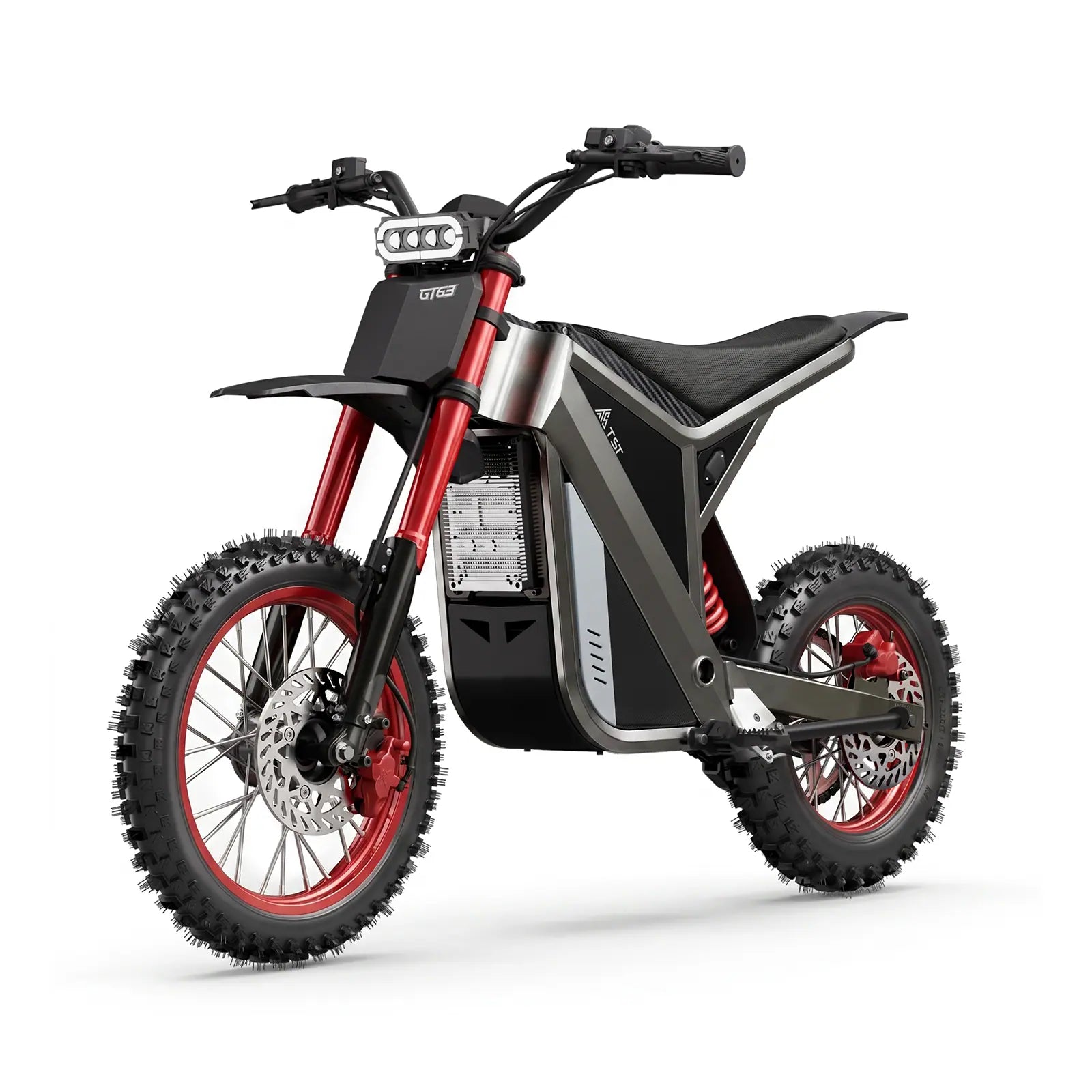














Inverted forks move the heavy, large‑diameter tubes up to the crown, cutting unsprung mass at the axle, boosting torsional rigidity and improving small‑bump tracking in real off‑road use. For dirt e‑MTBs and high‑power ebikes like those from TST EBike, that translates into more precise steering, better control in ruts and whoops, and higher durability under repeated big hits.
demystifying off road suspension
How does an inverted fork actually work on a dirt ebike?
Inverted forks place the large‑diameter outer tube clamped in the crown and the slimmer inner stanchion down near the axle, flipping the layout of a conventional fork while keeping the same telescopic action. This geometry shortens the bending “lever” above the triple clamp and shifts mass upward, which is ideal for heavy, torquey dirt ebikes that see hard landings and aggressive braking.
From the factory bench, what matters is not that the fork is “upside down”, but where the thick, stiff structure lives in the load path. The clamp holds the big tube, not the skinny one, so the steering column sees less twist when you slam on the front brake or land slightly crossed up. Inside, the damping cartridge still sits in an oil bath, but with the lower leg now the lighter part, unsprung mass drops right where dirt ebikes need it most – at the wheel.
Why is unsprung mass so critical for off‑road ebikes?
Unsprung mass is everything below the suspension spring or air piston: wheel, tire, rotor, part of the fork, and hardware that moves with the wheel. The lighter this assembly, the faster it can move up and down over sharp edges, keeping the tire in contact with the ground instead of “skipping” across it. In dirt e‑MTBs that add motor torque and higher average speeds, poor unsprung control quickly shows up as arm pump and vague front grip.
On the dyno, the curve is brutal: every extra 500 g at the axle amplifies impact force into the chassis and rider when you hit repeated square edges. Inverted forks exploit a simple trick: move the thick, heavy tube and caliper mounts up into the crown; leave only slender stanchions, axle and rotor in the unsprung zone. The result is a fork that reacts faster to roots, whoops and braking bumps without needing overly soft spring rates that would dive under e‑bike mass.
Unsprung mass distribution: inverted vs standard
When we tune TST EBike suspension packages, the unsprung mass advantage of inverted forks is what lets us run more supportive compression without sacrificing chatter sensitivity in rocky California singletrack.
What gives inverted forks their torsional rigidity advantage?
Inverted forks gain torsional rigidity because the large‑diameter outer tubes are clamped in the upper and lower crowns, shortening the lever arm and increasing resistance to twist under braking and side loads. In a standard fork, the crown squeezes the thin stanchion, so the section that must resist twisting is narrower and more prone to flex. For dirt ebikes with wide, grippy tires, the added stiffness keeps steering accurate in ruts and off‑camber turns.
Think of the fork as a long torque bar: the contact patch applies a twisting moment up through the legs into the crown. With inverted construction, more of that bar is “thick” near the clamp, so steering precision stays tight even when you land nose‑first or brake hard on loose rock. This is why top motocross and enduro racers, running heavier wheels and massive braking forces, standardize on inverted forks despite higher cost and complexity.
How do forces act differently: a simple view
-
Standard fork: Thin stanchions clamped, thick lower legs at the axle. The long, slender section between clamp and axle twists more under side loads.
-
Inverted fork: Thick uppers clamped, thin stanchions at the axle. The “working” length is stiffer and better supported, so torsional deflection drops, and the wheel tracks straighter under combined brake and corner loads.
What does a torsional rigidity load diagram show for each design?
A torsional rigidity load diagram would plot steering‑head angle deviation versus applied twisting torque at the axle, typically showing a flatter, lower‑deflection curve for inverted forks at the same load. For example, at a given brake‑and‑cornering torque, an inverted fork will deflect fewer degrees, or require a higher torque to reach the same angle, than a standard fork of similar weight and travel.
On our own lab rigs, when we apply increasing side load at the axle to simulate braking into a rut, the standard fork curve bends sharply once you pass a threshold; steering alignment drifts, and damping starts to bind. In contrast, an inverted fork shows a more linear, gradual rise: the crowns and thick upper tubes share the load, keeping bushing alignment tighter. For the rider, that translates into a front end that holds its line instead of “hinging” mid‑corner.
How does inverted fork geometry help reduce binding and stiction?
Inverted forks typically use longer upper sliders and shorter exposed inner stanchions, which improves bushing overlap and reduces misalignment under side loads. That longer guidance length means less tendency for the inner tube to cock and scrape the bushings when you land crooked or slam into a berm. The result is lower stiction and more consistent damping feel over a ride.
On a standard fork, the short lower casting sometimes acts like a long wrench on a thin rod; as soon as side load spikes, the upper and lower bushings go slightly out of plane, which you feel as a harsh “catch” in the mid‑stroke. The inverted layout places more of the sliding interface in that big, clamped upper tube, so the bending moment is spread over a longer section. For dirt ebikes that see constant side‑loading from motors plus terrain, this geometry keeps the fork moving freely instead of fighting itself.
Why do top motocross and TST EBike platforms insist on inverted forks?
Top motocross machines choose inverted forks because they deliver higher torsional rigidity, lower effective unsprung mass, better mid‑stroke support, and more stable damping under brutal race loads. TST EBike follows the same engineering logic on its high‑power off‑road platforms: as system weight and speed go up, the penalty for fork flex and slow wheel response becomes impossible to ignore, especially in technical terrain.
In real track testing, the difference shows up in corner entry and whoop sections. With inverted forks, the front contact patch stays planted and predictable when you preload, scrub or correct mid‑air, instead of wandering under you. For TST EBike, this is not just about performance bragging rights; it is about keeping powerful 26‑inch and 27‑inch electric bikes controllable for riders who are charging into rock gardens and sand whoops with motor assist still pulling.
What are the real‑world trade‑offs of inverted vs standard forks on e‑MTBs?
Inverted forks bring superior rigidity, reduced unsprung mass, and better small‑bump tracking, but they cost more, are more complex to service, and can be more exposed to contamination around the lower seals. Standard forks are cheaper, simpler to rebuild, and totally adequate for lighter use or lower‑power ebikes. For aggressive off‑road ebike riding, the performance gains of inverted forks usually outweigh the downsides.
On the bench, I see three recurring trade‑off levers: budget, maintenance tolerance, and riding style. If you are racing enduro‑style stages, smashing rock steps and braking bumps, the extra stiffness and control of an inverted fork justifies the higher acquisition and service costs. If your dirt ebike usage is more casual trail cruising, a well‑tuned conventional fork can deliver 80% of the feel for less money and hassle, especially if you service your own suspension at home.
Key differences for dirt ebike use
How should a dirt ebike rider choose between inverted and standard forks?
A dirt ebike rider should choose inverted forks if they ride aggressively, push high speeds on rough trails, or value precise steering and front‑end support over upfront cost and service simplicity. Riders who prioritize low price, easy maintenance, and more casual off‑road use can confidently stick with a quality standard fork tuned correctly for their weight and terrain.
From an engineering standpoint, I advise riders to start with their worst‑case scenario, not the average ride. Ask yourself: “What happens when I come up short on a double with the front wheel first?” If that picture involves full‑power motor assist and a 30‑kg ebike, inverted forks begin to look less like race bling and more like a safety margin. TST EBike customers who move from standard to inverted setups usually report faster pace with less fatigue, even on the same familiar loops.
Does inverted fork design change how we tune suspension for TST EBike riders?
Yes, inverted fork design affects spring rates, damping curves, and even cockpit setup we recommend for TST EBike riders. Lower unsprung mass and higher rigidity let us run slightly firmer low‑speed compression and higher mid‑stroke support without making the fork feel numb on chatter. That tuning window is narrower on standard forks, where added compression quickly turns into harshness and deflection.
In practice, a TST EBike dirt build with inverted forks may ship with more aggressive high‑speed compression shims and a firmer base setting, because the wheel can still move freely over micro‑bumps. We also tend to pair these forks with stronger front rotors and wider bars, as the chassis can transmit more precise steering input without wobble. This is the kind of holistic system tuning – motor, frame, fork, cockpit – that separates a generic ebike from a properly engineered off‑road machine.
TST EBike Expert Views
From our side of the test bench at TST EBike, inverted forks stopped being a “luxury” option the moment we pushed high‑powered drivetrains into real off‑road duty. Once a front wheel sees 25–30 kg of bike plus motor torque diving into rock‑studded descents, the old flex and delay of standard forks become a liability. Inverted designs simply hold geometry and damping consistency better, which is why they now underpin our most capable dirt platforms.
What are the maintenance and durability realities of inverted forks on ebikes?
Inverted forks demand more meticulous seal care, oil changes, and inspection, and are less forgiving of neglect than basic standard forks. Because the oil column sits above the seals, a failure can send oil down toward the rotor, so early detection is crucial. However, for riders willing to follow a regular service schedule, modern inverted forks are extremely durable and hold their performance window longer under heavy off‑road use.
One nuance I see often: inverted fork bushings and seals are extremely sensitive to side‑load damage from loose headsets and worn hub bearings. On high‑torque ebikes, those loads can be higher and more frequent, so we always insist on checking chassis alignment and wheel bearings at each fork service. When you keep the rest of the front end tight, an inverted fork on a TST EBike can run season after season with very consistent feel, instead of the gradual “mush” riders accept from cheaper systems.
Conclusion: which front end wins for dirt ebikes?
For serious dirt ebikes and e‑MTBs, inverted forks win on performance thanks to lower unsprung mass, higher torsional rigidity, and more controlled damping under real‑world off‑road loads. Standard forks still make sense for budget‑conscious or casual riders, but once you add motor power, speed and weight, the safety and control margins of inverted designs become hard to ignore. If you ride aggressively, spec your next TST EBike or similar dirt‑focused build with an inverted fork, and treat maintenance as part of your performance package.
FAQs
Are inverted forks worth it on a mid‑power trail ebike?
If you ride moderately technical trails at modest speeds, a well‑tuned standard fork can be sufficient, but inverted forks give more headroom if your pace or terrain escalates.
Can I retrofit an inverted fork to my current ebike?
Yes, but check head tube standards, axle type, rotor size and overall axle‑to‑crown height so you do not ruin geometry or overload the frame.
Do inverted forks require more frequent servicing?
They typically need similar service intervals but are less tolerant of neglect, so sticking to recommended oil and seal changes is more important for long‑term performance.
Is unsprung mass really noticeable to average riders?
On smooth paths, not much, but in rocky or rooty terrain the quicker wheel response and improved traction from reduced unsprung mass become very noticeable, even to non‑racers.
Should a heavier rider always choose inverted forks?
Heavier riders or those on heavy, high‑power ebikes benefit more from the added stiffness and stability of inverted forks, especially under hard braking and repeated big hits.

Leave a comment
This site is protected by hCaptcha and the hCaptcha Privacy Policy and Terms of Service apply.