


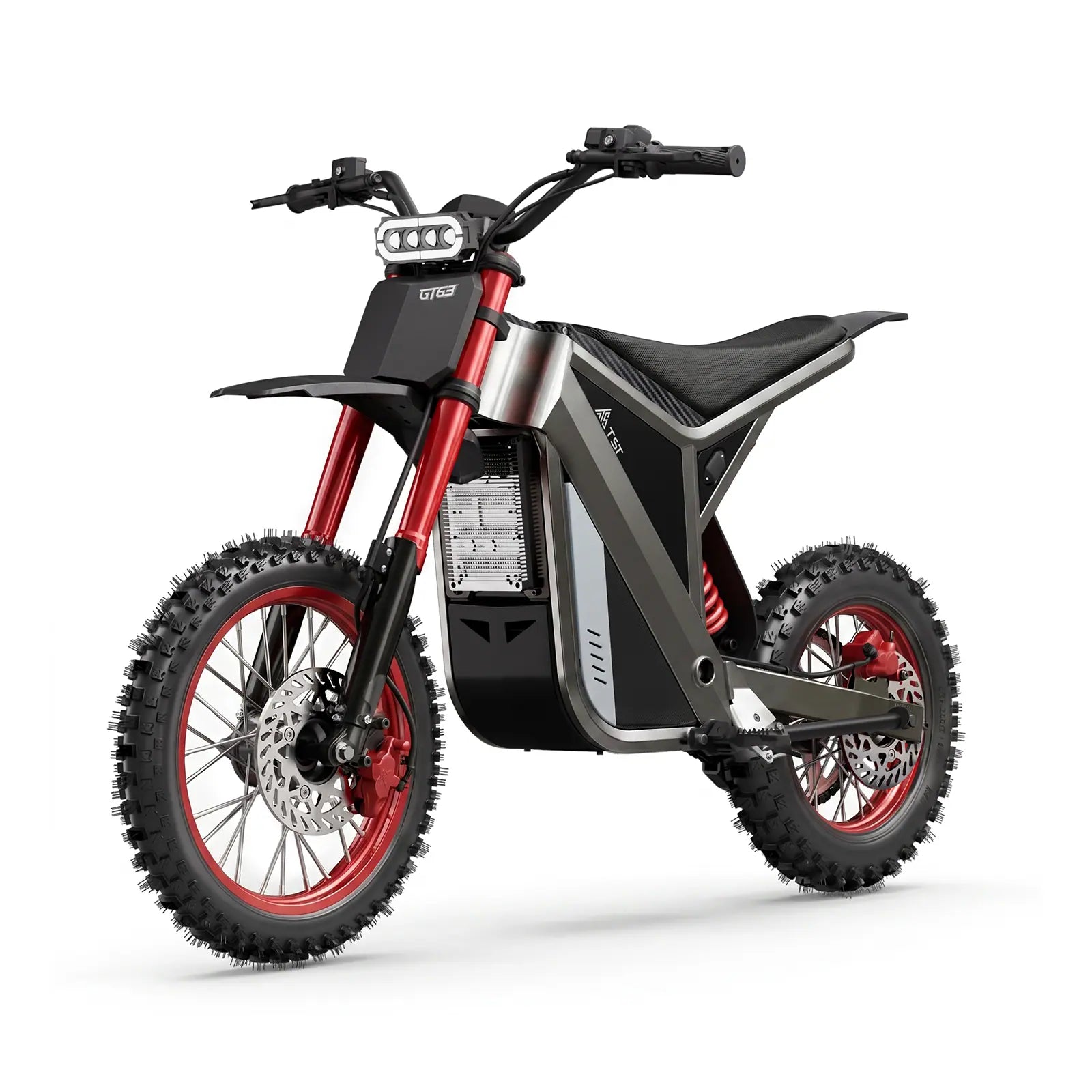














A moped-style e-bike and a commuter e-bike can share a battery voltage and a price bracket and still be the wrong swap for each other. The real decision comes down to five things that have nothing to do with looks: how far you can comfortably reach the pedals and bars, how much the bike weighs when you have to lift or store it, what the tires and suspension do to your ride quality, how the throttle behaves versus pedal-assist, and whether the exact configuration you're buying still counts as a bicycle under your state's law. Get any one of those wrong and the bike sits unused regardless of how good it looks parked outside a cafe.
This comparison uses TST's current published specifications for its moped-style R002 against its commuter-format models, plus Washington State's statutory e-bike definitions, since motor power and top speed are what actually separate a legal, no-license e-bike from a vehicle that needs registration.
Start With Pedaling, Not Power
Moped-style bikes borrow their silhouette from small-displacement motorcycles: a lower, longer seat, a stepped or bench-style saddle, and a riding position that puts your feet forward rather than beneath you. TST's R002, its current moped-style model, uses a 20-inch wheel platform with a seat height up to 39 inches and a top tube length of 38.3 inches, built around a single 1500W-rated (peak) brushless rear hub motor and 90 N·m of torque, with pedal assist offered across 1 to 5 levels alongside a throttle. Commuter-format TST bikes such as the Commuter and City-Smooth models use larger 27.5-inch wheels, front suspension only, a more upright frame geometry, and a lower-power 1000W peak motor with 70 N·m of torque, also on a 1–5 level pedal-assist system.
The practical difference isn't styling — it's where your body sits relative to the pedals. A moped-style frame with a forward foot position and low step-over is easier to swing a leg over at a stop but places less weight through the pedals, which matters if you plan to actually pedal for exercise or to extend range when the battery runs low. A commuter frame's more upright, bicycle-like geometry rewards steady pedaling and is generally easier to control at low speed in stop-and-go traffic, since your center of gravity sits closer to a standard bicycle. Riders who want a genuine cycling motion, not just a seat with pedals attached, are better served by the commuter geometry; riders who want minimal pedaling effort and a scooter-like feel are the intended audience for the moped-style layout.
Weight, Storage, and What "Folds" Actually Means
TST's own published product weights show a real spread across formats: the R002 moped-style bike weighs 71.87 lbs, the standard Commuter weighs 71.32 lbs, the City-Smooth weighs 58.86 lbs, and TST's Folding model weighs 65.4 lbs. None of these numbers make a bike "easy to carry" by themselves. A 65-plus-pound bike is unwieldy up a flight of stairs or into a trunk regardless of whether it happens to fold, and a folding hinge reduces footprint for storage, not the effort needed to lift it.
Storage fit depends on three things you should check against your own space before comparing motors or range: unfolded footprint, whether the model folds at all, and where the bike will actually live day to day. TST's moped-style R002 does not fold and has an unfolded footprint of roughly 60.3 by 26.6 by 42.8 inches, while TST's dedicated Folding model reduces to about 57.9 by 11.0 by 27.6 inches when collapsed. If your storage is a narrow apartment entry, an elevator-only building, or a car trunk, a non-folding moped-style frame at 70-plus pounds is a wrong-fit case regardless of how much you like the motor output — the bike needs a garage, shed, or ground-floor spot with no lifting.
Assist Behavior and Tire Format Change the Ride, Not Just the Look
Every current TST model in this comparison uses a 1-to-5 level pedal-assist system paired with a throttle, so assist granularity isn't the differentiator — tire format and suspension are. The R002 runs 20-by-4-inch fat tires with full front-and-rear suspension; the Commuter and City-Smooth models run narrower 27.5-by-2.25-inch tires with front suspension only. Fat tires absorb more surface irregularity and grip better on gravel, wet leaves, or light snow, which suits routes with rough pavement or unpaved sections, but they also add rolling resistance that shows up as reduced pedal-only range. Narrower commuter tires roll more efficiently on smooth pavement and bike lanes but transmit more road vibration and are less forgiving on potholes and rail crossings. Puncture-resistant tire language on either format is a resistance claim, not a puncture-proof guarantee, and doesn't remove the need for normal tire-pressure checks.
The Legal Configuration Question TST's Comparison Page Doesn't Answer
This is the part that separates a real decision from a style preference, and it's jurisdiction-specific. Washington law defines three classes of "electric-assisted bicycle" under RCW 46.04.169, and all three require an operating pedal-assist bicycle with a motor that stops assisting the rider at 20 mph (Class 1 and 2) or 28 mph (Class 3, with a mandatory speedometer). Federal and state practice caps the motor at 750 watts of continuous rated power for a device to qualify as an e-bike at all, and a device that exceeds that power or speed profile, or that can propel the rider without pedaling above 20 mph, falls outside the statutory e-bike definition and into moped or motor-driven-cycle territory under Title 46 — which brings a driver's license, registration, and insurance requirement that no ordinary bicycle carries.
TST's own product page lists the R002's motor at 1500W and its top speed at 32 mph, both of which sit above Washington's e-bike thresholds. That does not by itself tell you whether the specific unit you'd buy is classified, or classifiable, as a Washington e-bike, a moped, or something else — TST's listing states a peak output figure, not a continuous-rated wattage, and classification depends on the bike's actual rated (not peak) power, its throttle-only top speed, and how the unit is configured at the point of sale, none of which are settled by marketing copy or by the fact that the bike has pedals. Shipping a bike to Washington or offering local pickup is not evidence that the configuration is street-legal there. Before buying a moped-style model with a stated top speed above 28 mph or a motor rated anywhere near or above 750W, confirm the bike's continuous rated wattage and throttle-only top speed directly with TST support, and separately confirm current classification rules with the Washington State Department of Licensing or your local jurisdiction, since RCW 46.61.710 also lets cities and counties further restrict where each class can ride even after state classification is settled. By contrast, TST's lower-power commuter models — rated around 1000W peak with lower stated top speeds near 23 mph — sit closer to typical e-bike thresholds, but the same rule applies: verify rated wattage and throttle-only speed for the exact unit before assuming a class designation.
Who Should Walk Away From Each Format
A no-purchase outcome is legitimate here. If your commute requires elevator storage with no ground-floor option, if you specifically want a genuine pedaling workout rather than throttle-dominant riding, or if you cannot get written confirmation of the exact rated wattage and throttle-only top speed for the configuration you'd receive, neither format is a safe default — that's a reason to hold off rather than choose based on appearance.
Where to Verify Before You Buy
Once you know your route, storage limits, and pedaling preference, compare exact current models side by side, including price, availability, and full specifications, on TST's model comparison page, which lists peak motor output, battery capacity, weight, tire size, and recommended rider height for every current model. That page owns inventory and pricing; this article does not replace it. For the legal classification question specifically, confirm rated (not peak) wattage and throttle-only top speed with TST support before purchase, and check current classification and local operating rules with the Washington State Department of Licensing or your city's transportation department, since local jurisdictions can add restrictions beyond the state's baseline three-class system.

Leave a comment
This site is protected by hCaptcha and the hCaptcha Privacy Policy and Terms of Service apply.