
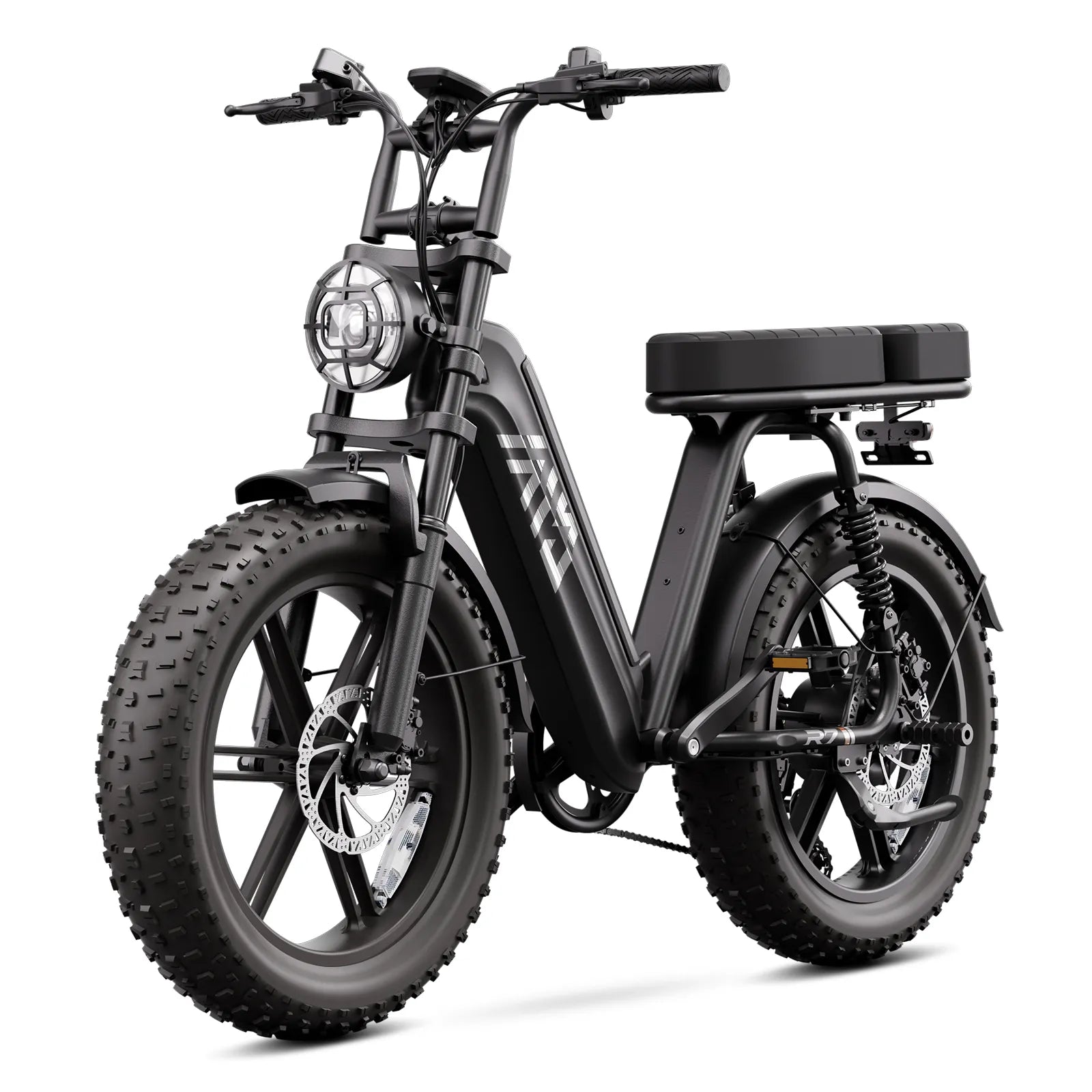
















To keep traction in deep wet mud, you need wide, low-pressure tires with an open, self-cleaning tread that actively sheds mud and water as the wheel turns. Narrow tires sink and clog; 26x4.5 inch tubeless fat tires float on the surface and clear their knobs. With smooth throttle and correct body position, a TST EBike fat-tire setup can crawl through ruts where normal tires simply spin.
the hardcore off road ebike guide
Why do narrow off-road tires lose traction and get stuck in deep mud?
Narrow off-road tires lose traction in deep mud because their small contact patch produces high ground pressure, causing them to sink and cut into the soft layer. Once buried, their tighter tread pattern packs with mud, turning the tire into a slick cylinder that spins and slips instead of biting and propelling the bike forward.
In practice, a 2.1–2.4 inch “normal” trail tire behaves like a knife in pudding: it slices down until it meets firmer ground—if there is any. In deep slop, the tire sinks to the rim, and the sidewalls start plowing, greatly increasing drag. At the same time, closely spaced knobs fill with mud and water, eliminating the edges needed for mechanical keying against the terrain.
On the test track, I watch this happen visually: after just a few wheel rotations in wet clay, a narrow tire’s tread becomes a uniform brown tube. You can add more motor power on a TST EBike, but all you do is polish the mud—forward grip barely increases, while the risk of a sideways slide skyrockets.
How do 26x4.5 inch fat tires “float” and keep traction in deep wet dirt?
26x4.5 inch fat tires “float” by spreading the bike’s weight over a much larger footprint, reducing ground pressure so they ride on top of the mud instead of slicing down into it. At low pressures, the casing deforms around ruts and roots, maintaining contact, while the wide tread keeps enough clean lugs engaged to generate forward drive.
Think of a snowshoe versus a high heel: the fat tire is the snowshoe. With roughly twice the width and a larger contact patch, the load per square centimeter is dramatically lower, so the tire deforms the top layer of mud rather than punching straight through. In our mud troughs, 4.5 inch tires visibly ride higher, keeping the rim and bottom bracket out of the muck.
On TST EBike’s 26-inch fat platforms, I typically run 6–12 psi in deep mud. At those pressures, the tire footprint lengthens and widens, and the contact patch wraps around uneven surfaces, creating countless tiny “hooks” that resist slip. The feel at the bars is a slow, tractor-like crawl instead of a nervous, knife-edge slide.
What is the role of low tire pressure in muddy traction and self-cleaning?
Low tire pressure allows the casing to deform, increasing the contact patch and letting the tread conform to the mud’s micro-shapes. This not only boosts grip but also enhances self-cleaning: as knobs flex and release, they fling mud outward under centrifugal force, keeping tread blocks exposed and ready to bite again.
From a mechanic’s view, a stiff, high-pressure tire acts like a rigid drum: once the tread fills with mud, it stays packed because the knobs hardly move. At lower pressure, each knob compresses as it enters the contact patch, then rebounds as it leaves the ground. That flexing “pumps” mud and water out of the gaps between lugs.
On TST EBike fat-tire setups, I watch this happen in slow-motion video: at 5–8 psi, knobs squish into the mud, then snap back, launching thin arcs of muck away from the wheel. That dynamic deformation is what maintains working edges on the tread, even in fully saturated clay sections.
How does tread pattern design improve mud shedding and water evacuation?
Tread pattern improves mud shedding by using tall, widely spaced lugs, angled channels, and open shoulder zones that give mud and water a clear path outward as the tire rotates. Directional V-shaped center blocks pump material backward and sideways, while staggered side knobs carve and release the slurry away from the contact patch.
A good mud tread is not just “knobby”—it’s intentionally sparse. The gaps between knobs are large enough that mud can escape rather than getting trapped. As the tire spins, centrifugal force and the mechanical flick of each knob push mud into these voids and then out toward the shoulders. The result is a tread that constantly re-exposes sharp rubber edges to the ground.
On TST EBike’s off-road fat tires, you’ll notice:
-
A central, ramped row for rolling efficiency on firmer ground.
-
Deep, offset intermediate blocks that act like paddles in soft mud.
-
Open shoulders that let mud and water fling off sideways instead of building a “sidewall of slime”.
This pattern is literally engineered to stay dirty but functional, not polished smooth and useless.
Why do “self-cleaning” fat tires stay grippy when normal tires turn into slicks?
Self-cleaning fat tires stay grippy because their tread blocks are tall, flexible, and separated by wide channels that prevent continuous mud films from forming. As each block rolls through the contact patch, it compresses and then snaps back, using its stored elastic energy to eject stuck mud and water.
Normal tires with tight, shallow tread give mud nowhere to go. The gaps fill, surface tension and suction hold the slurry in place, and the tire quickly becomes a smooth, mud-coated cylinder. Any remaining edges are buried under a moving sleeve of wet dirt, so friction drops sharply.
In our lab’s “sticky clay” drum tests, self-cleaning fat tires reach a steady state where some mud remains but distinct, clean block faces are always visible. Narrow tires, under the same conditions, settle into a uniform brown coat. That difference in visible rubber is the difference you feel as “traction vs. no traction” when you ask a TST EBike to claw out of a boggy section.
How does tread-block motion generate the “tread pattern mud ejection” effect?
Tread-block motion generates mud ejection through a sequence of compression, shear, and rebound. As a knob enters the contact patch, it compresses and shears against the mud, forcing it into the lateral channels. As it exits, the knob rebounds, releasing stored energy and flinging mud outward via centrifugal force.
Imagine a single center knob:
-
Approach: It’s clean or lightly dirty.
-
Contact: It squashes into the mud, pressing material into surrounding voids.
-
Shear: The wheel’s rotation drags it backward, scraping mud off the ground and into side channels.
-
Release: As it leaves the ground, the knob springs back, and the mud—now unsupported—slingshots away from the tire.
On a 26x4.5 fat tire at ebike speeds, each knob cycles through this pattern many times per second. In practice, this means the tire is continuously “resetting” its contact patch, a dynamic process you simply don’t get on flatter, more tightly packed XC treads.
What is the physics behind traction and slippage in deep wet mud?
Traction in deep wet mud depends on both friction and mechanical interlock. Once a thin water film and liquefied mud layer form, pure friction drops dramatically, so your tire must “bite” into solid structures below and around the mush. Slippage occurs when shear stress from the tire exceeds the shear strength of the mud and any mechanical keys.
At the contact patch, two things can happen when you apply torque:
-
The tire deforms and lugs push into firmer material, creating a network of tiny wedges that resist motion.
-
Or the mud yields first, shearing internally so the tire simply carves through without anchoring.
Wide, low-pressure 26x4.5 tires increase the chance of the first outcome by spreading load, reducing the depth at which mud yields, and engaging more knobs simultaneously. On a TST EBike, that translates into forward creep with controllable spin, rather than a sudden breakaway into a sideways slide.
How should you modulate throttle, PAS, and body position to maintain grip in mud?
You should modulate throttle and PAS gently, avoiding sudden torque spikes that break traction. Use lower assist levels, smooth cadence, and slight rearward but centered body position to keep weight over the driven wheel without unloading the front. Micro-adjusting line choice and staying loose at the bars lets the bike hunt for grip without fighting you.
In deep mud, more power is not always better. Abrupt throttle on a high-torque TST EBike can instantly exceed the mud’s shear strength, spinning the rear tire and digging a hole. Instead, treat the motor like a tractor: roll on slowly, feel for bite, and only increase assist once the tire is already moving forward.
From the saddle, I cue riders to:
-
Slide hips slightly back, but keep chest low enough to maintain steering precision.
-
Keep elbows bent and hands relaxed so the front wheel can wander a bit without causing panic.
-
Look ahead, not at the front tire, and commit to a smooth, unhurried line.
This technique, combined with fat, self-cleaning tires, is what gets you through the slop rather than stuck in it.
Which terrain types truly benefit from 26x4.5 inch tubeless fat tires on a TST EBike?
26x4.5 inch tubeless fat tires shine in deep mud, loose sand, fresh snow, and mixed root-and-rock trails where low-speed stability matters more than outright speed. They provide flotation, grip, and forgiveness in conditions where normal tires bog down, knife into ruts, or buck riders off line.
For many TST EBike riders, that means:
-
Winter fire roads and forest access after storms.
-
Spring shoulder-season trails with standing water and saturated soil.
-
Beach approaches and dune edges.
-
Slow-speed, technical climbs over wet roots and embedded rocks.
Tubeless setups add another layer of performance: you can run lower pressures without pinch flats, and sealant plugs small punctures that would otherwise strand you deep in the woods. In real-world testing, tubeless 26x4.5s on a TST EBike feel like you’ve bolted on four-wheel drive.
TST EBike Expert Views
“When we spec 26x4.5 inch tires on TST EBike platforms, it’s not just for the ‘fat bike look’. In our mud trough tests, narrow 2.3s sink until the pedals nearly kiss the surface and their treads glaze over in seconds. The 4.5s, aired down and run tubeless, ride higher and keep shedding mud through the tread blocks. I’ve watched riders roll slowly but steadily through sections where normal tires just spin and trench. The engineering goal is simple: give you a wide, low-pressure, self-cleaning contact patch so your ebike behaves like a light ATV in the slop, not a road bike that wandered off course.”
Conclusion: How can you master mud riding mechanics and keep traction in deep wet dirt?
To master mud riding mechanics, think in terms of flotation, self-cleaning, and control. Swap narrow, high-pressure tires for 26x4.5 inch low-pressure tubeless fat tires with open, directional tread. Let the casing deform and the lugs flex to shed mud and keep edges exposed. On the bike, ease into throttle and PAS, keep your weight balanced over the driven wheel, and ride at a deliberate, tractor-like pace. Combined with a well-tuned TST EBike, these techniques transform deep, wet dirt from a trap into a playground, where you can crawl, float, and claw your way through instead of spinning helplessly in place.
FAQs
Is tire width or tread pattern more important for mud traction?
Both matter, but width usually comes first. Wide 4.5 inch tires reduce sinking and increase contact patch; an open, aggressive tread then ensures the tire stays self-cleaning and grippy instead of turning into a slick.
Can I ride deep mud with standard 2.3 inch mountain bike tires?
You can, but expect much more sinking and clogging. Standard tires work in light mud or mixed conditions; in truly deep, wet trails, fat, low-pressure tires are dramatically more forgiving and effective.
What pressure should I run in 26x4.5 inch tires for mud?
Many riders use roughly 6–12 psi in deep mud, adjusting for rider weight and terrain. Lower pressures increase flotation and grip but risk rim strikes if you hit sharp rocks at speed—tubeless helps.
Do tubeless setups really help in muddy conditions?
Yes. Tubeless allows lower pressures with less risk of pinch flats and lets sealant handle small punctures from debris you can’t see under the mud. It also eliminates tube friction inside the tire, improving casing suppleness.
Is a fat-tire TST EBike harder to pedal on firm trails or pavement?
Compared with narrow tires, fat rubber feels slower on smooth pavement due to more rolling resistance. But for riders who regularly see mud, sand, or snow, the added traction and confidence often outweigh the small efficiency loss on firm surfaces.

Leave a comment
This site is protected by hCaptcha and the hCaptcha Privacy Policy and Terms of Service apply.