

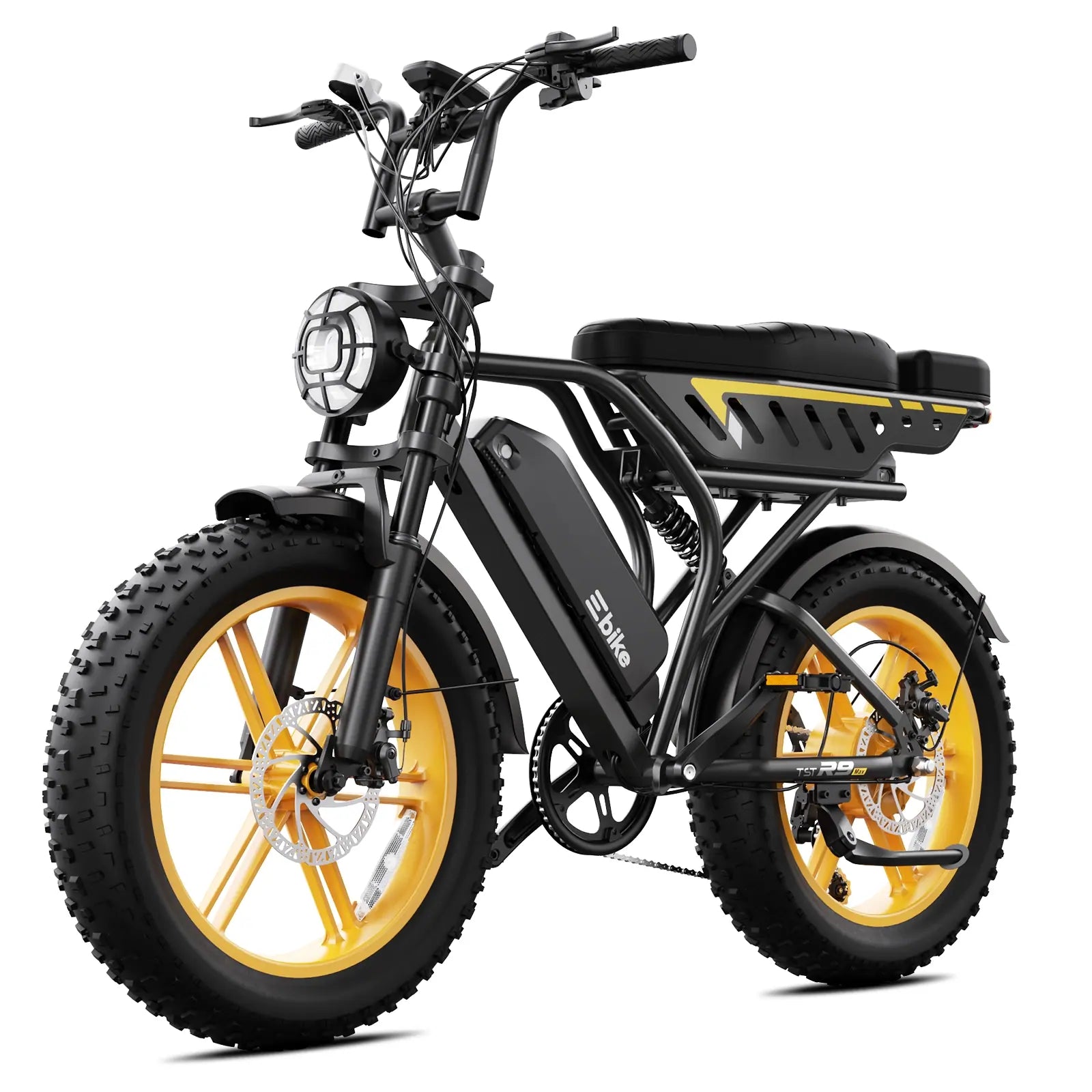
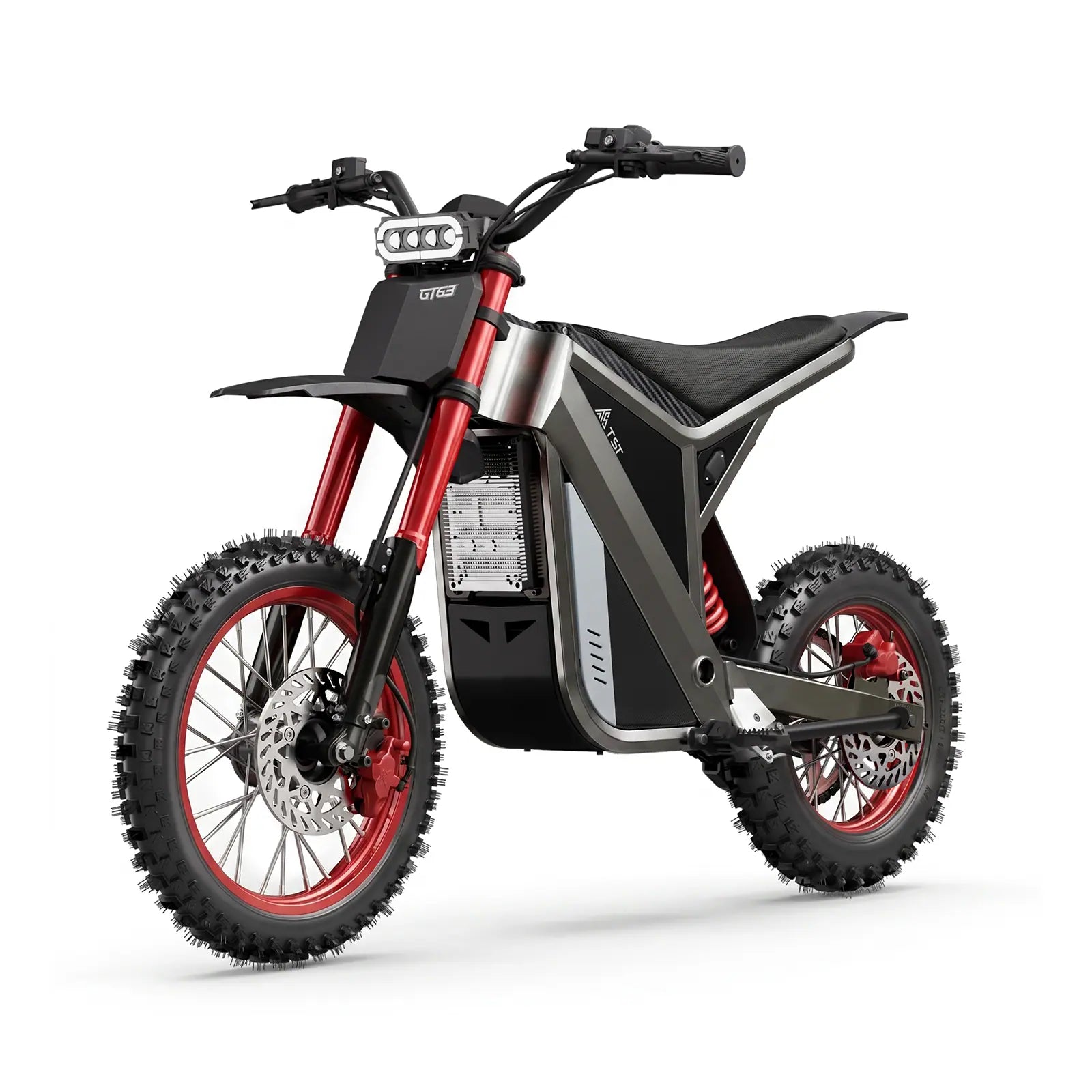









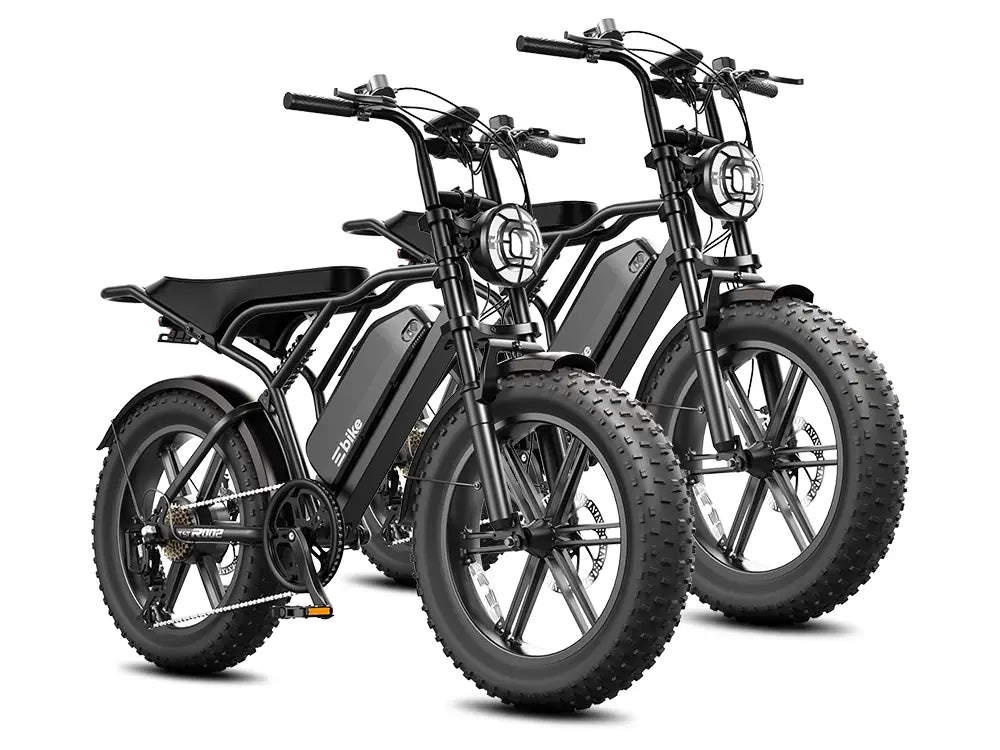
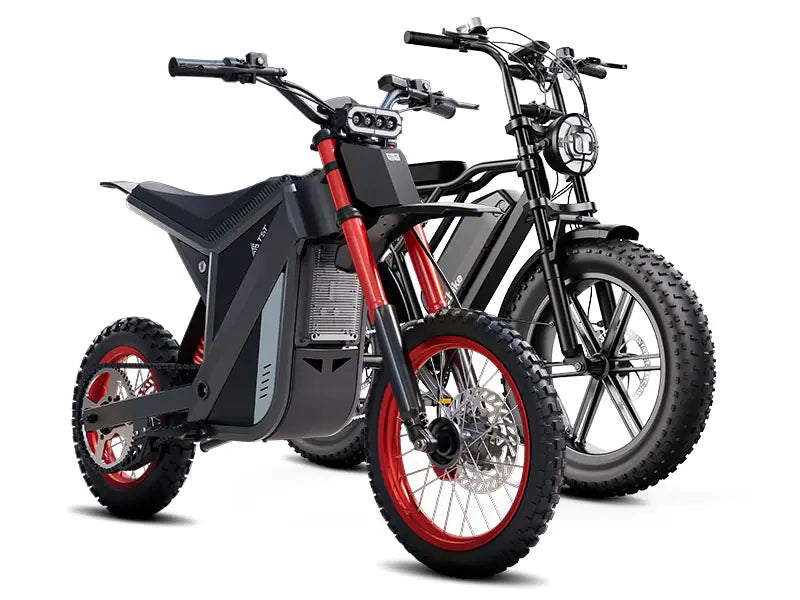

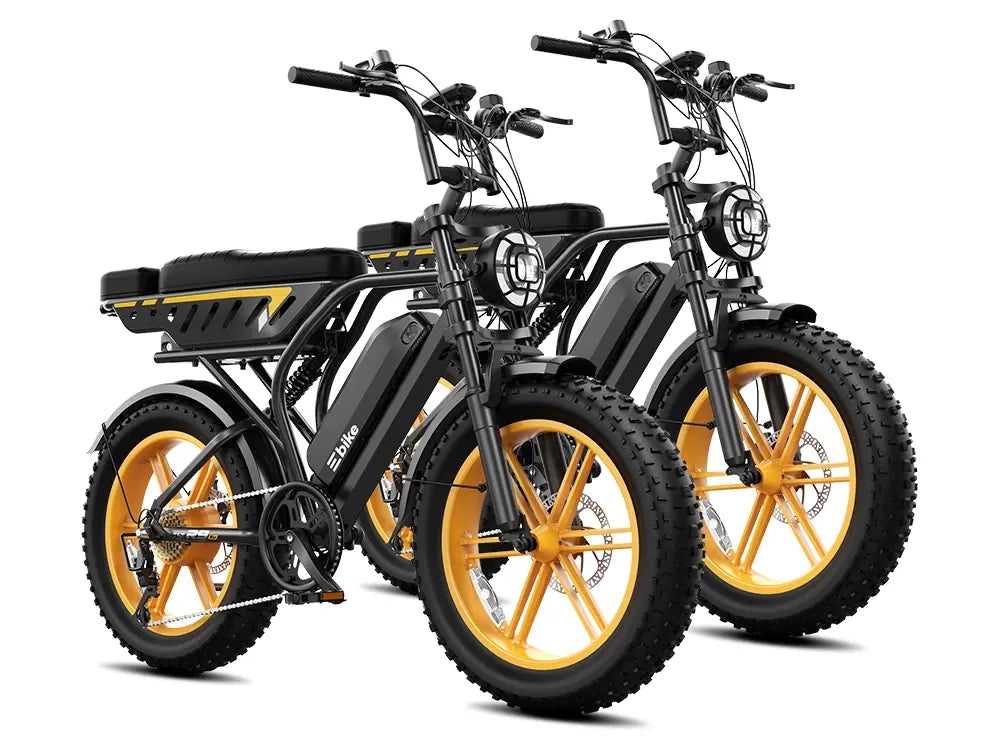

An all‑wheel‑drive dual‑motor fat tire e‑bike uses front “pull” and rear “push” to clamp the contact patch into the terrain so torque rises only as traction allows, not beyond it. Through fast electronic torque distribution and fat tire deformation, the system keeps each wheel near its grip limit, reducing sand spin and enabling confident climbs on loose gravel slopes.
the all terrain fat tire ebike guide
How does dual‑motor AWD prevent loose sand front‑wheel spin?
A dual‑motor AWD fat tire e‑bike prevents loose sand spin by blending front‑wheel traction control with rear‑wheel torque support. The front motor senses load changes through current and speed, while the rear motor adds progressive push so no single wheel exceeds its grip limit, allowing smooth, claw‑like forward motion on soft, shifting terrain.
From a factory engineering perspective, I treat each hub motor like a controllable “torque spring” between the stator and the ground. When you hit deep sand, the front tire wants to surf and dig simultaneously. If only the rear drives, weight transfer unloads the front, making steering vague. In dual‑motor AWD, as soon as the controller detects front wheelspeed trying to rise faster than vehicle speed, it trims front torque and lets the rear motor shoulder more work. This keeps the front tire in a high‑sidewall‑deformation state instead of a free‑spinning trench‑digging state, so you steer with a loaded, grippy contact patch rather than a plowing paddle.
On fat tires, sidewalls and carcass stiffness matter as much as motor power. A properly tuned AWD e‑bike like those from TST EBike uses slightly lower front tire pressure in loose sand, increasing the footprint length. That expanded “shoe print,” combined with balanced torque, reduces the shear stress per unit area beneath the front lugs. In practice, I can watch the sand flow around the tread instead of exploding behind the wheel. You still see some rooster tail, but it is controlled, indicating micro‑slip rather than full traction loss. This is the mechanical foundation for confident, zero‑panic steering on beaches and dune approaches.
What is the front‑pull and rear‑push climbing logic on loose gravel slopes?
Front‑pull and rear‑push climbing logic keeps the front tire slightly traction‑limited for steering while the rear tire carries the bulk of drive torque. The front motor “hooks” the bike into the slope and stabilizes direction, and the rear motor compresses the tire into the surface, converting available normal force into forward thrust without sudden spin‑outs on broken gravel.
Imagine a steep gravel ramp of mixed pea stones and dust. With only rear drive, as you load the throttle, the rear tire overwhelms local grip and creates a rolling gravel bed, while the unpowered front oscillates between under‑steer and washing out. In the lab, we see this as a sudden jump in rear wheelspeed with little change in vehicle speed. When I prototype a dual‑motor system, I tune the control curves so the front motor takes 30–40% of available torque at the onset of a climb. This pulls the chassis forward, pre‑loads the fork, and points the steering into the hill.
As the slope increases, weight shifts aft. A smart controller then hands off more torque to the rear motor, often reaching 60–70% of total drive from the back hub. The critical nuance is ramp rate: if rear torque rises too fast, the tire breaks the granular interlock between stones; if it rises too slow, you lose momentum and stall. On properly set‑up all‑terrain e‑bikes, the controller computes this balance every few milliseconds. You feel it as a continuous, tractor‑like shove instead of the on‑off spinning that plagues single‑motor hardtails on the same hill.
Why is all‑wheel‑drive torque distribution critical on fat tire e‑bikes?
All‑wheel‑drive torque distribution is critical on fat tire e‑bikes because fat tires can generate huge traction but also huge drag and sudden breakaway. Intelligent front‑rear torque splits let the system exploit the big contact patch without overloading it. This prevents efficiency losses, sidewall overheating, and unpredictable slides when transitioning between sand, gravel, and firm ground.
From a design seat, the worst thing you can do with a fat tire is assume “more rubber = immune to slip.” In testing, I routinely see fat tires on single‑motor bikes either under‑used (low torque, low efficiency) or abused (sudden spin, then violent re‑grip that twists spokes and chews sidewalls). With dual‑motor AWD, I can treat each wheel independently. For example, entering a soft sand patch from hardpack, front tire load increases sharply as it climbs its own bow wave. If torque distribution stays 50:50, the front digs; if it shifts quickly to 30:70, the rear keeps pushing while the front is allowed to plane.
On variable surfaces like mixed gravel and embedded rock, I use slightly asymmetric torque maps: the front motor’s maximum phase current is capped lower than the rear’s. That way, even if the front momentarily grabs a rock edge, torque cannot spike enough to unweight the rear. The net effect is a self‑stabilizing system where each wheel is always close to, but rarely beyond, its optimal slip ratio. For brands like TST EBike, which target both off‑road and commuting, this tuning is what separates a fun, controllable bike from a spec‑sheet‑only powerhouse.
How does dynamic torque distribution vectoring work between front and rear axles?
Dynamic torque distribution vectoring works by continuously measuring wheel speeds, motor currents, and sometimes pedal input, then adjusting front and rear torque outputs in real time. The controller shifts the torque vector forward or backward depending on traction, slope, and acceleration demand, ensuring each wheel operates near its optimal slip without uncontrolled spin or stall.
In engineering terms, I picture the torque vector as an arrow on a front‑rear axis. On level, grippy ground under moderate pedal assist, that arrow can sit near the center, say 50:50. Hit a sandy incline and the algorithm starts to see front wheel slip (rising wheelspeed without matching chassis acceleration) and increased motor current for a given speed. The controller then rotates the vector rearward, maybe to 30:70, within a few control cycles. This is not a simple fixed map; it is closer to a feedback controller tuned for stability and responsiveness.
The subtlety that most marketing copy misses is timing. If the controller reacts too fast, the rider feels judder as torque oscillates. Too slow, and the front already dug in. In prototype test rides, I log current, wheelspeed, and IMU data and then adjust the vectoring gains so that torque transfer feels almost anticipatory. When you move your weight forward to chase front grip, the system cooperates, adding a bit more front torque; when you hang back for a steep punch, rear torque comes in strong but still within traction limits. The result is that “zero drama, full send” climbing behavior that advanced riders immediately notice.
Front–rear torque distribution reference table
This table reflects the kind of practical tuning envelope I use rather than a rigid rule set. Real controllers constantly move within these bands as conditions change under the tires.
How are torque direction and vector diagrams used to model AWD e‑bike behavior?
Torque direction and vector diagrams model AWD e‑bike behavior by representing each wheel’s torque as an arrow aligned with the wheel plane and centered at the contact patch. Engineers sum these vectors with gravity and normal forces to predict whether the bike will climb, slip, or wheelie on a given slope and substrate, then tune controllers and geometry accordingly.
On a loose gravel slope, I draw the bike on a free‑body diagram with gravity acting down the hill, normal forces perpendicular to the surface, and front and rear drive torques acting tangentially at the contact patches. Each motor’s torque vector is split into a component overcoming gravity and a component consumed by surface deformation and slip. If the sum of forward components is less than the downslope gravity component, the bike stalls; if much greater, one wheel spins.
When I overlay torque vectors for different controller strategies, the picture becomes intuitive. A rear‑drive bike shows a long rear vector and a tiny, purely rolling front vector; the hinge between them is the wheelbase. With AWD, the front vector grows and shifts the resultant closer to the bike’s center, reducing the overturning moment that causes rear‑end squat or front‑end lift. For designers, this is not just drawing; we feed these models into multibody simulations and then check them against instrumented test rides on sand pits and gravel ramps to refine both hardware (weight distribution, tire choice) and software (torque ramp rates, cut‑back thresholds).
What makes fat tire contact patch mechanics unique in AWD sand and gravel riding?
Fat tire contact patch mechanics are unique because the large volume and width allow significant shape change under load, distributing pressure over a bigger area. In AWD sand and gravel riding, this deformable footprint works like a low‑pressure track, but only if torque is matched to the patch size and soil strength, avoiding rut‑forming over‑shear.
In our test lab, I often ink the tire and roll it across calibrated sand trays to visualize footprint evolution with load and pressure. A 4‑inch fat tire at low pressure can lengthen its contact patch by 40–60% when you add throttle and hit an incline. On rear‑drive bikes, most of that extra area is used at the back, while the front stays relatively unloaded. With AWD, as you feed some torque into the front, it too “squats” into the sand, doubling the effective tractive surface without doubling local pressure.
Gravel behaves differently: instead of flowing, it rearranges. Here the fat tire’s rounded profile lets stones roll under the tread blocks. If one wheel carries all the drive torque, it quickly polishes a marbles‑on‑concrete layer. With both wheels sharing torque, each patch sees less shear, so the top stones remain keyed against each other. The payoff is less sudden collapse of the gravel structure and a more predictable transition between grip and controlled slip. TST EBike leverages this by pairing fat rubber with robust rims and spokes, allowing riders to run lower pressures off‑road without compromising wheel durability.
Tire size, terrain, and use‑case table
From an OEM standpoint, 26‑inch fat formats maximize flotation and low‑speed crawl control, while 27‑inch options strike a balance between roll‑over speed and urban efficiency.
Which rider techniques complement AWD torque control on loose climbs?
Rider techniques that complement AWD torque control on loose climbs include smooth throttle modulation, deliberate weight shifts, and line choice that preserves undisturbed surface. By riding “with” the controllers—feeding predictable inputs and staying relaxed—you let the dual‑motor system maintain steady slip instead of forcing abrupt breakaways.
I coach test riders to imagine the throttle as a volume knob, not a switch. On a sandy or gravel slope, roll power in over one to two seconds while keeping cadence steady. This gives the controller enough time to detect traction limits and adjust torque distribution. Shifting your hips slightly forward loads the front tire so the AWD system can actually use the front motor’s potential; hanging too far back defeats the purpose and leaves the front surfing.
Line choice matters more on AWD because you can exploit surfaces that single‑motor bikes avoid. For example, a thin layer of firmer, damp sand near vegetation may support both wheels well. With dual motors, you can track straight through this band with minimal steering correction. When you do feel micro slips, resist the urge to chop throttle entirely. Instead, ease off 10–20% while staying committed; this allows the controller to settle torque without losing the momentum essential for soft‑surface climbing.
How does dual‑motor AWD compare to rear‑hub only on steep loose terrain?
Dual‑motor AWD outperforms rear‑hub only on steep loose terrain by reducing single‑wheel load, distributing torque, and stabilizing steering. Rear‑hub bikes often oscillate between spin and bog, while AWD maintains continuous traction with less energy wasted as heat and roost, translating into more consistent climbing and less rider fatigue.
On pure numbers, a strong rear‑hub motor can match or exceed a dual‑motor system’s peak torque, but real slopes are not dyno rollers. In field tests, I see rear‑drive fat bikes quickly dig trenches in beach sand climbs. Once the trench forms, the tire shoulders drag against the walls, current spikes, and controller temperatures rise. With AWD, both tires climb closer to the surface, so the total mechanical work against drag is lower even if electrical power is similar.
Steering is the other major difference. Rear‑hub bikes on loose gravel tend to under‑steer as the rear pushes a light, unpowered front. When you add a front motor, the steering axis is actively pulled into alignment with your intended path. The bike tracks straighter, correcting micro‑slides before they evolve into full washes. Riders report that, on the same hill, they can climb one or two gears higher in cadence and still feel in control. That kind of practical margin is what makes AWD fat tire bikes from companies like TST EBike attractive to riders who routinely face steep, loose access roads or shoreline trails.
What TST EBike design choices matter most for AWD sand and gravel performance?
TST EBike design choices that matter most for AWD sand and gravel performance include robust fat tire wheel builds, carefully chosen tire sizes, and controller tuning that favors stable, tractable torque over flashy peak numbers. Geometry that keeps rider mass centered between axles also maximizes the benefits of dual‑motor traction on soft and broken terrain.
From a product‑planning standpoint, TST EBike’s focus on high‑power yet cost‑effective platforms means the frames and wheels are overbuilt for the stresses of soft‑surface torque. Reinforced spokes and rims tolerate the low pressures and side loads you see when carving ruts or powering through drifted snow. Offering both 26‑inch and 27‑inch formats lets riders match their primary terrain: 26‑inch for aggressive off‑road, 27‑inch for mixed city‑trail use with occasional loose climbs.
Controller philosophy is equally important. Instead of chasing the absolute highest peak wattage, TST EBike emphasizes repeatable, thermally stable output. That matters on long sand climbs, where a bike with impressive short‑burst power may fold back as components overheat. In a dual‑motor configuration, thermally conservative tuning on each hub yields a combined system that can sustain serious torque for much longer. The result is a bike that feels strong not just in the parking lot sprint, but after several minutes of grinding up a loose fire road or dune face.
TST EBike Expert Views
“When we tune dual‑motor fat tire e‑bikes for sand and gravel, we don’t start with ‘How do we hit the biggest peak wattage?’ We start with ‘What torque curve keeps both tires right at the edge of grip for as long as the hill lasts?’ That means softer ramp‑in, smarter front‑rear bias, and wheels built to survive thousands of micro‑slips without going out of true.”
Are there practical maintenance tips to keep AWD fat tire systems reliable off‑road?
Practical maintenance tips include regularly checking spoke tension, cleaning connectors, and monitoring tire pressure tailored to terrain. Keeping firmware up to date and inspecting motor cables for abrasion maintains reliable torque distribution. A clean, well‑tensioned wheelset and sealed electrical system preserve the precise control AWD requires on sand and gravel climbs.
I advise riders who frequently hit beaches and gravel roads to establish a post‑ride ritual. First, rinse salt and fine dust off hubs, brake rotors, and connectors with low‑pressure water, then dry thoroughly. Blow or brush sand away from axle exits and cable grommets so abrasive particles do not work into seals. Monthly, pluck spokes like strings and listen for uniform tone; fat tires hide tension issues until they become serious, and AWD torque will quickly exploit a weak wheel.
Tire pressure checks are non‑negotiable. A few PSI too high, and your contact patch shrinks, over‑loading local soil; too low, and sidewalls over‑flex and heat up. For dual‑motor bikes, consistent pressures front and rear matter even more, because the controller assumes certain deformation characteristics when interpreting current draw as a proxy for traction. Finally, schedule periodic inspections of controller settings and logs with a technician if your bike supports it. Subtle changes in current limits or error counts can reveal early issues before they strand you at the bottom of a remote sandy climb.
Is dual‑motor AWD always the right choice for every rider and terrain?
Dual‑motor AWD is not always the right choice; it excels in loose, steep, or low‑traction conditions but adds weight, cost, and complexity. Riders focused on smooth urban commuting may prefer a lighter single‑motor setup, while those regularly tackling sand, snow, and gravel climbs will benefit most from AWD’s traction and stability advantages.
From a system‑engineering view, every added motor brings extra copper, magnets, wiring, and control logic. That means more mass to accelerate and more components to protect from water and dust. If your typical week consists of paved bike paths and mild park trails, the extra traction envelope of AWD may go unused while you still pay the penalty in weight and slightly higher drag. A well‑spec’d rear‑hub bike will feel more agile in tight city riding.
However, for riders in coastal areas, mountain towns, or regions with long unpaved access roads, the calculus flips. Here, the ability to maintain forward motion when surfaces soften or steepen is not a luxury; it is the difference between riding and walking. I often frame it this way: if more than 30% of your riding time happens on loose or marginal terrain, dual‑motor AWD pays back its complexity with confidence and reduced risk of crashes from surprise loss of traction. Brands like TST EBike lean into this segment, optimizing frames and electronics around the demands of all‑terrain use rather than treating AWD as a bolt‑on novelty.
Can you summarize key takeaways and actions for riders considering AWD fat tire e‑bikes?
Dual‑motor AWD fat tire e‑bikes use intelligent front‑rear torque distribution, fat tire contact patch management, and vector‑based control to prevent loose sand and gravel spin while maximizing climbing power. Riders should match tire size and system type to terrain, adopt smooth techniques that complement controllers, and maintain wheels and electronics diligently for long‑term off‑road reliability.
If your riding includes steep loose climbs, beach approaches, snow, or broken gravel roads, AWD offers tangible benefits: more stable steering, fewer spin‑outs, and reduced fatigue from wrestling the bike. Look for designs that prioritize controller tuning and wheel robustness over raw peak watt numbers, and consider platforms from experienced builders such as TST EBike. Spend time learning throttle control and weight shifting, and treat tire pressure as a key tuning knob, not an afterthought. With those pieces in place, dual‑motor AWD becomes less about spec sheet bragging and more about unlocking terrain that used to be off‑limits.
FAQs
Are AWD fat tire e‑bikes harder to ride for beginners?
Most beginners adapt quickly because AWD feels more stable and predictable on loose terrain; starting in lower assist levels and practicing smooth throttle helps ease the learning curve.
Can I ride a dual‑motor AWD e‑bike only with the rear motor to save battery?
Many systems let you reduce or disable front assist, but real‑world range often improves using both motors moderately rather than overworking a single rear hub on hills.
Does dual‑motor AWD significantly reduce battery life or range?
AWD can consume more power at high outputs, but efficient torque sharing and less wheel spin often offset losses, especially on climbs where single‑motors waste energy digging and slipping.
Is a 26‑inch fat tire better than 27‑inch for beach sand?
For pure beach and soft sand use, 26‑inch fat tires usually provide better flotation and low‑speed traction, while 27‑inch suits riders mixing sand sections with regular commuting.
Who should prioritize AWD over a powerful single‑motor e‑bike?
Riders who frequently tackle steep loose climbs, soft sand, snow, or remote gravel tracks should prioritize AWD, as the added traction and control provide a larger real‑world performance advantage.

Leave a comment
This site is protected by hCaptcha and the hCaptcha Privacy Policy and Terms of Service apply.